
2023.1.31

What can the survey results reveal about the current state of small and medium-sized manufacturing companies in Japan?
STANDAGE Co., Ltd. (Headquarters: Minato-ku, Tokyo; Representative Director: Akinori Adachi), which operates "DigiTrad," a one-stop support service for trade operations, conducted a survey on the actual state of overseas expansion in the manufacturing industry among 100 managers and executives of small and medium-sized manufacturing companies (100 to less than 300 employees) that have not yet expanded overseas.
Survey Summary
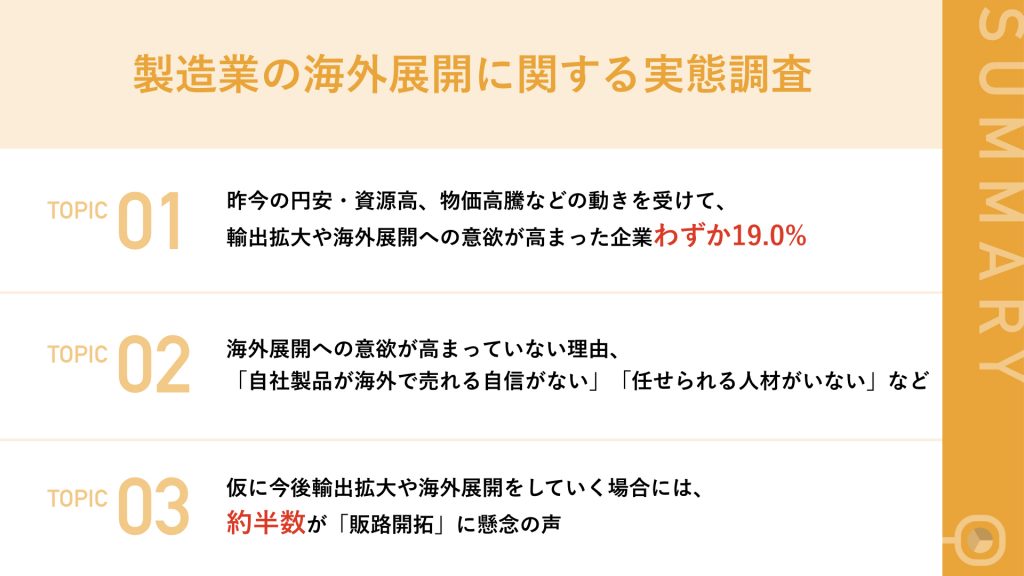
In response to recent trends such as the weak yen, rising resource prices, and soaring inflation, only 19.01 TP3T companies have expressed increased interest in expanding exports and overseas operations.
"Q1. Has your company seen increased interest in expanding exports or overseas operations in response to recent trends such as the weak yen, rising resource prices, and soaring prices?"When asked (n=100),"Significantly increased" was 5.01 TP3T, and "Slightly increased" was 14.01 TP3T.The answer was:
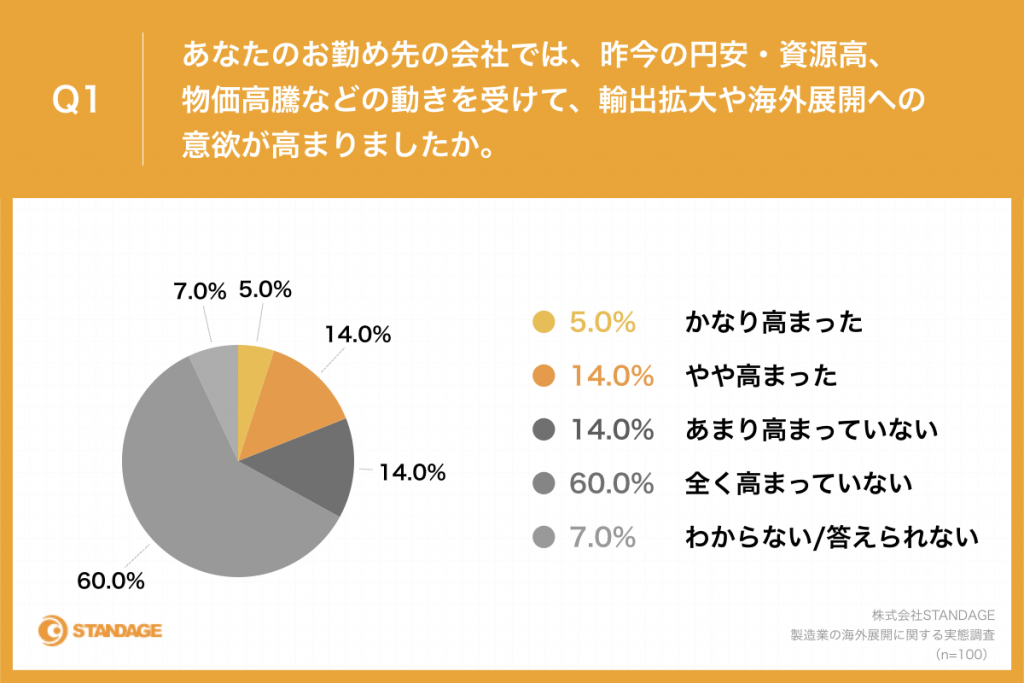
- Significantly increased: 5.0%
- Slightly increased: 14.0%
- Not increasing much: 14.0%
- Not increasing at all: 60.0%
・I don't know/cannot answer: 7.0%
The most common reason for increased desire to expand overseas was "because the Japanese market is shrinking," cited by 52.61 TP3T.
For those who answered "significantly increased" or "somewhat increased" in Q1,"Q2. Given the recent trends of a weaker yen, higher resource prices, and soaring inflation, please tell us why your desire to expand exports and overseas operations has increased. (Multiple answers allowed)"When asked (n=19),"Because the Japanese market is shrinking" received 52.61 TP3T, "Because it is easier to profit from exports due to the weak yen" received 47.41 TP3T, and "Because we are considering sourcing parts and materials overseas" received 15.81 TP3T.The answer was:
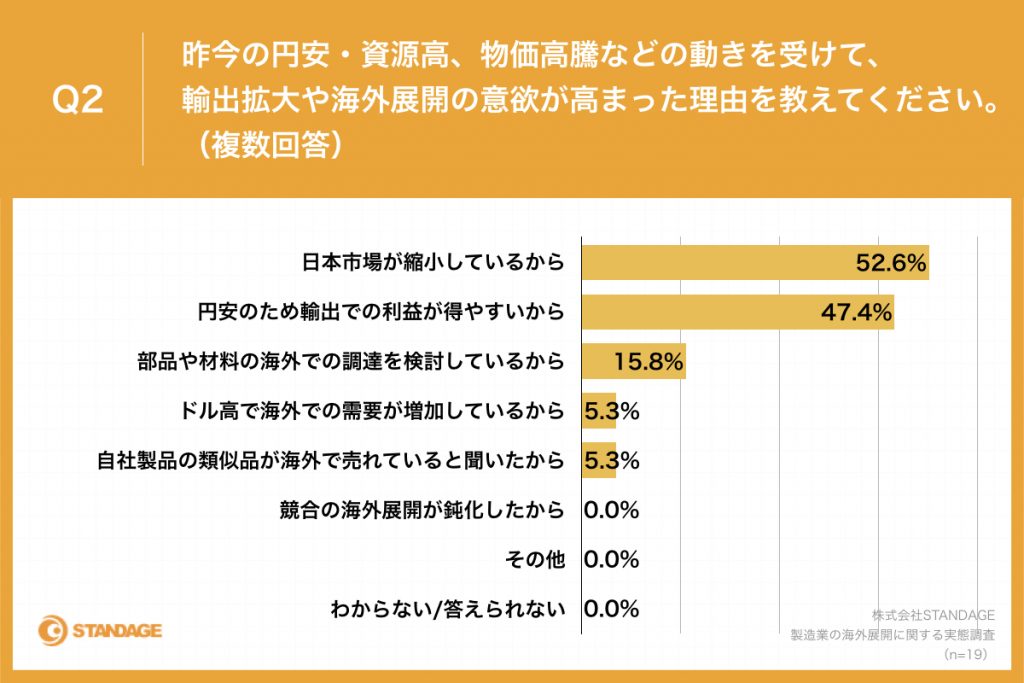
- Because the Japanese market is shrinking: 52.6%
- Because the weak yen makes it easier to profit from exports: 47.4%
- Because we are considering sourcing parts and materials from overseas: 15.8%
- Because the strong dollar is increasing overseas demand: 5.3%
- Because I heard that similar products to ours are selling well overseas: 5.3%
- Because competitors' overseas expansion has slowed down: 0.0%
・Other: 0.0%
・Don't know/can't answer: 0.0%
Other reasons include "declining profits" and "the attractiveness of growing overseas markets."
For those who answered anything other than "I don't know/I can't answer" in Q2,"Q3. Please tell us any other reasons, besides those you answered in Q2, that have increased your desire to expand exports or enter the overseas market. (Open-ended response)"When asked (n=19),"Decreased profits" and "Attractiveness of growing overseas markets"We received 12 responses, including these.
<Free answers, excerpts>
・Age 54: Profits decreased.
63 years old: Because the growing overseas markets are attractive.
・Age 56: Strong demand overseas.
・Age 50: Because it's seen as an affordable option from overseas, which puts me in a position to participate in races.
Reasons for the lack of enthusiasm for overseas expansion include "lack of confidence that our products will sell overseas" and "lack of personnel who can be entrusted with the task."
For those who answered "Not increasing much" or "Not increasing at all" in Q1,"Q4. Please tell us why your desire to expand exports or enter the overseas market is not increasing. (Multiple answers allowed)"When asked (n=74),"We lack confidence that our products will sell overseas" was cited by 36.51 TP3T, "We don't have the personnel to entrust the task to" by 36.51 TP3T, and "We can't find a suitable partner" by 28.41 TP3T.The answer was:
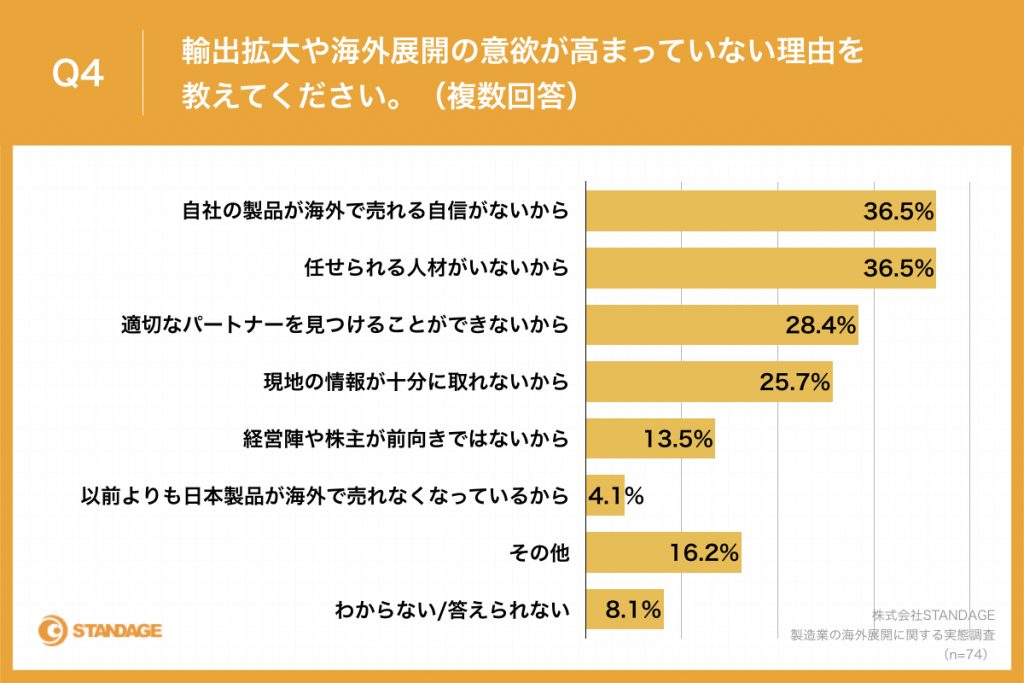
- Because they lack confidence that their products will sell overseas: 36.5%
- Because there is no one who can be entrusted with the task: 36.5%
- Because I can't find a suitable partner: 28.4%
- Because sufficient local information cannot be obtained: 25.7%
- Because management and shareholders are not positive: 13.5%
- Because Japanese products are selling less overseas than before: 4.1%
Other: 16.2%
-50 years old: Because we only handle products for the domestic market.
-60 years old: Because it's yen trading.
- 51 years old: Because the production volume is low to begin with.
- 54 years old: As a locally focused company, we are not considering expanding into other regions.
・I don't know/cannot answer: 8.1%
Other reasons include "high export costs" and "inability to compete with overseas companies on cost."
For those who answered anything other than "I don't know/cannot answer" in Q4,"Q5. If there are any other reasons why your desire to expand exports or enter the overseas market is not increasing, please feel free to tell us. (Open-ended response)"When asked (n=68),"Because export costs are high" or "We can't compete with overseas companies on cost."We received 45 responses, including those mentioned above.
<Free answers, excerpts>
63 years old: Because export costs are high.
・Age 50: We can't compete with overseas companies in terms of cost.
64 years old: No longer desires further business expansion.
・Age 55: No base of operations.
・Age 56: I'm worried about whether I can cope with the risks of exchange rate fluctuations.
61 years old: Products with high export restrictions.
47 years old: Because our company's products are not easily affected by exchange rate fluctuations.
・62 years old: Because the company's structure is basically B2B limited to the domestic market.
If we were to expand exports or enter the overseas market, 21.0% would assume a timeframe "longer than 5 years."
"Q6. If your company were to consider expanding exports or overseas operations, what timeframe would you want to consider?"When asked (n=100),"Within 3 years" accounted for 14.01 TP3T, and "Longer than 5 years" accounted for 21.01 TP3T.The answer was:
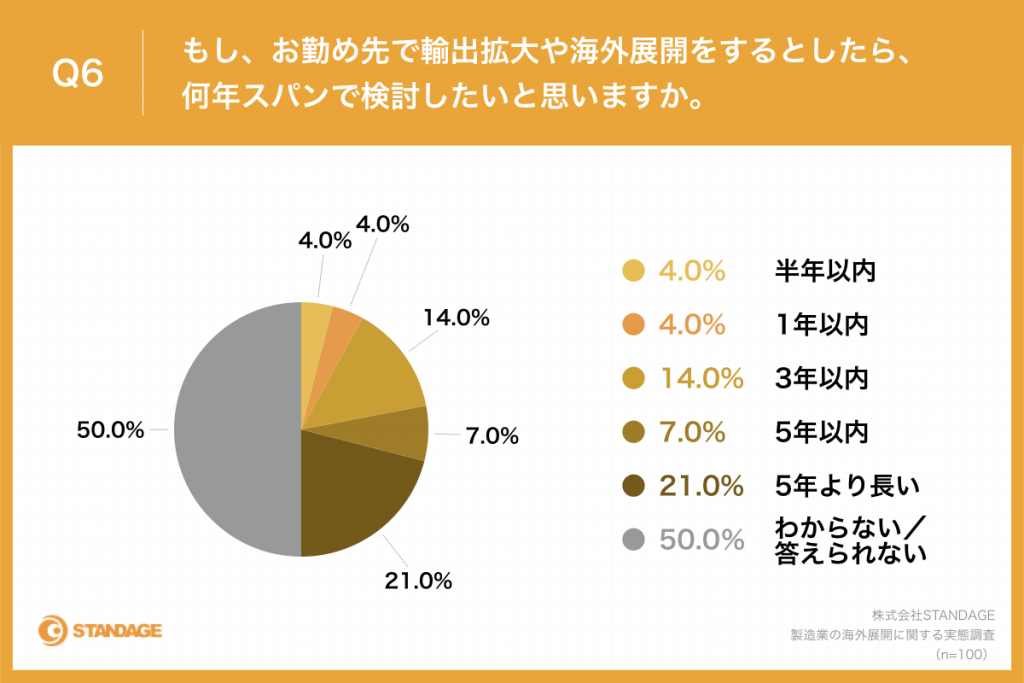
・Within half a year: 4.0%
・Within 1 year: 4.0%
・Within 3 years: 14.0%
・Within 5 years: 7.0%
• Longer than 5 years: 21.0%
・Don't know/Can't answer: 50.0%
When considering expanding exports or overseas operations in the future, about half of the respondents expressed concerns about "developing sales channels."
"Q7. If your company were to expand exports or expand overseas in the future, what challenges do you think it might face? (Multiple answers allowed)"When asked (n=100),"Difficulty in developing sales channels" was cited by 47.01 TP3T, "Concerns about negotiating and contracting with buyers" by 39.01 TP3T, and "Lack of know-how regarding trade" by 38.01 TP3T.The answer was:
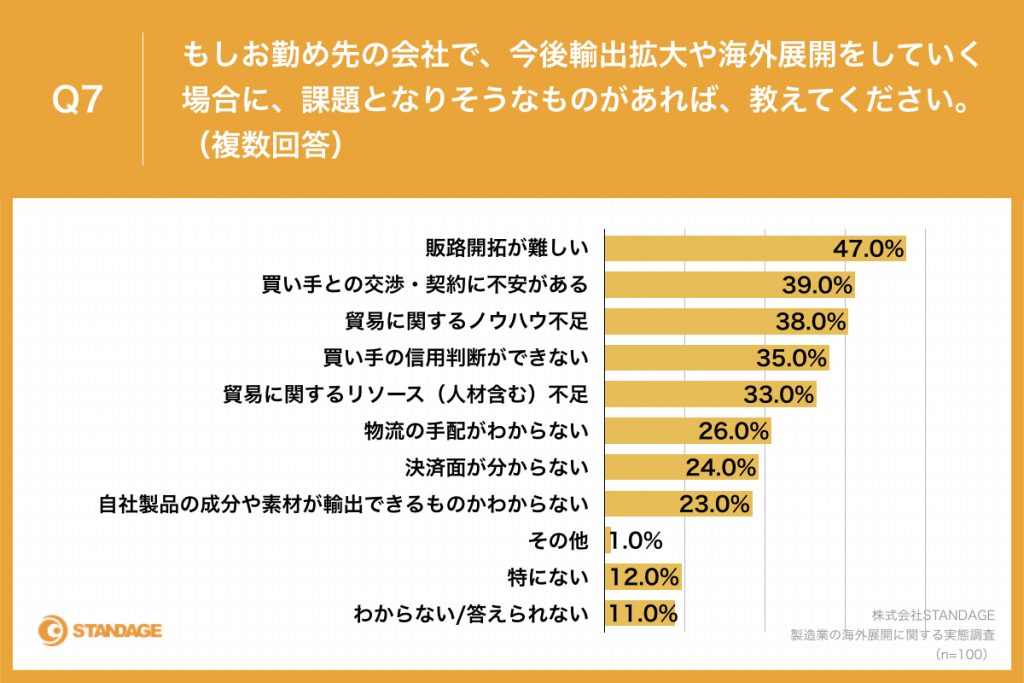
・Difficulty in developing sales channels: 47.0%
- I have concerns about negotiating and contracting with the buyer: 39.0%
Lack of expertise regarding trade: 38.0%
- Inability to assess the buyer's creditworthiness: 35.0%
- Shortage of trade-related resources (including personnel): 33.0%
- I don't know how to arrange logistics: 26.0%
- Payment details are unclear: 24.0%
- Unsure whether the ingredients and materials in our products are exportable: 23.0%
Other: 1.0%
- 51 years old: Improvement of product production
- Nothing in particular: 12.0%
・I don't know/cannot answer: 11.0%
Other challenges include "securing local personnel" and "not knowing how to respond when problems occur."
For those who answered anything other than "Nothing in particular" or "Don't know/Can't answer" in Q7,"Q8. In addition to the answers given in Q7, please feel free to tell us about any other challenges you anticipate facing when expanding exports or overseas operations in the future. (Open-ended response)"When asked (n=77),"Securing local personnel" and "not knowing how to handle problems when they occur" are common concerns.We received 44 responses, including those mentioned above.
<Free answers, excerpts>
・Age 58: Secured local personnel.
63 years old: I don't know how to handle problems when they occur.
65 years old: Securing intellectual property rights.
51 years old: Increased product production volume.
41 years old: Interest rate fluctuations.
61 years old: Legal restrictions.
・Age 50: Digital and security-related.
・65 years old: Transportation costs alone result in a deficit.
One in four companies that have no interest in overseas expansion is interested in a "complete outsourcing service for all aspects of overseas trade."
For those who answered "Not increasing much" or "Not increasing at all" in Q1,"Q9. If there was a service that could handle everything related to international trade, from market development and negotiations to settlement and logistics, would you consider expanding your exports or going overseas?"When asked (n=74),"Strongly agree" received 1.41 TP3T, and "Somewhat agree" received 21.61 TP3T.The answer was:
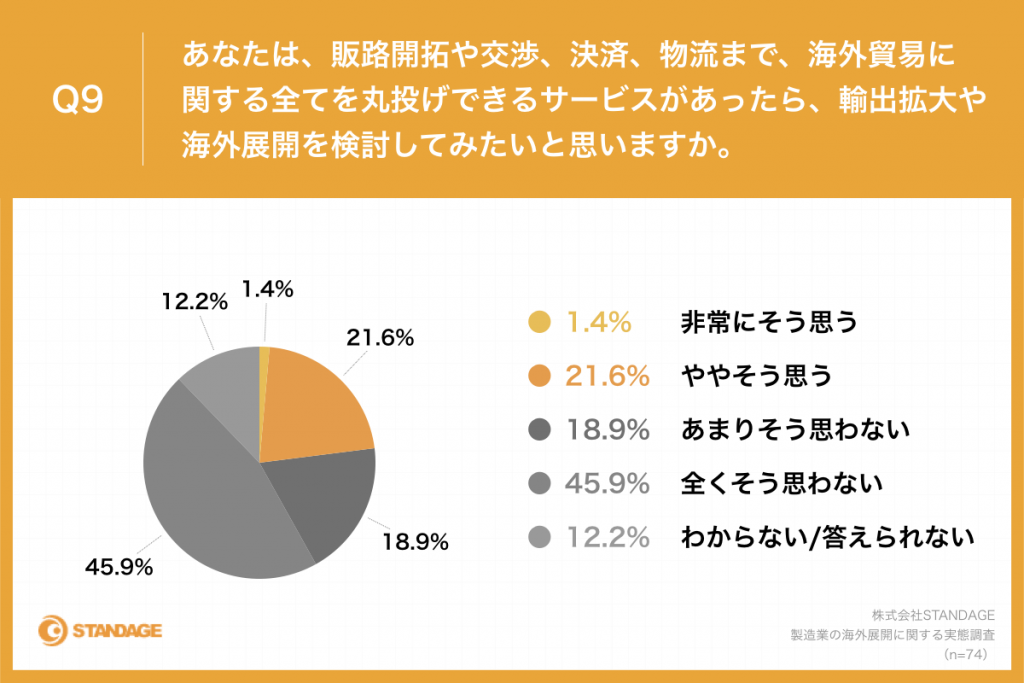
I strongly agree: 1.4%
・Somewhat agree: 21.6%
I don't really think so: 18.9%
・Completely disagree: 45.9%
・I don't know/cannot answer: 12.2%
The top two markets to focus on when expanding overseas are Southeast Asia (1st place) and North America (2nd place).
"Q10. If your company were to expand its exports or overseas operations, which overseas markets would you like to focus on?"When asked (n=100),"Southeast Asia market": 26.01 TP3T, "North America market": 21.01 TP3T, "Europe market": 18.01 TP3TThe answer was:
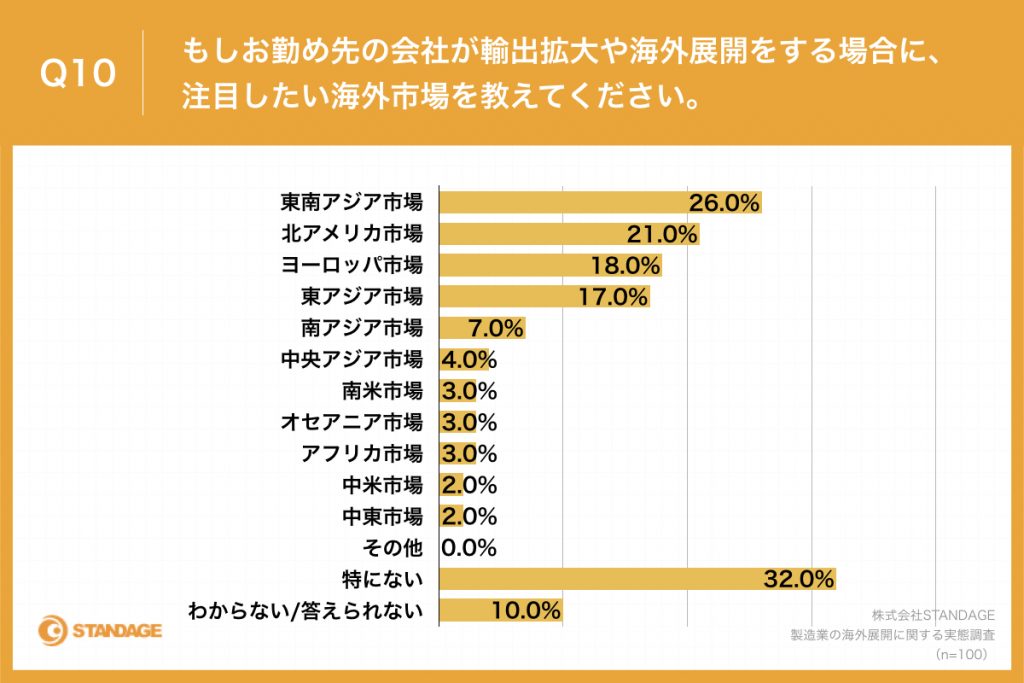
Southeast Asian market: 26.01 TP3T
North American market: 21.01 TP3T
• European market: 18.0%
East Asia Market: 17.01 TP3T
• South Asia market: 7.0%
Central Asian market: 4.0%
・South American market: 3.0%
Oceania market: 3.0%
African market: 3.0%
・Central American market: 2.0%
・Middle East market: 2.0%
・Other: 0.0%
- Nothing in particular: 32.0%
・I don't know/cannot answer: 10.0%
summary
This time, we conducted a survey on the actual state of overseas expansion in the manufacturing industry among 100 managers and executives of small and medium-sized manufacturing companies (with 100 to less than 300 employees) that have not yet expanded overseas.
In response to recent trends such as the weak yen, rising resource prices, and soaring inflation, only 19.01 companies reported increased interest in expanding exports or overseas operations. Reasons for this lack of interest included a lack of confidence that their products would sell overseas and a lack of suitable personnel, indicating that companies perceive significant hurdles. Even if they were to expand exports or overseas operations in the future, about half of the companies expressed concerns about "developing sales channels," suggesting that few manufacturers are looking to expand overseas despite the challenges in the domestic market.
In 2022, a year marked by the weakest yen in approximately 20 years, it is anticipated that the rising cost of imported raw materials will reduce the positive impact on profitability for small and medium-sized manufacturers whose main market is domestic. While this could be seen as a tailwind for export entry and expansion, and the Ministry of Economy, Trade and Industry has expressed support, it seems that there are significant hurdles to actually entering the export market. Furthermore, there are reports of companies that attempted to enter overseas markets but ultimately withdrew due to business strategy, suggesting that while overseas markets are attractive, it is difficult for small and medium-sized manufacturers to look overseas without factors that alleviate their anxieties.
"DigiTrad" Overview
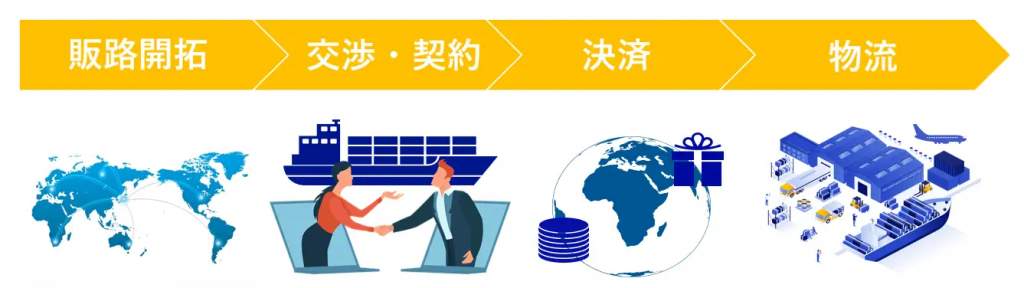
"DigiTrad" is a comprehensive trade package service developed exclusively by Standage that provides a one-stop service covering everything from sales channel development to negotiations, contracts, settlements, and administrative procedures related to logistics and customs clearance.
More than 99% of the companies that make up Japan's manufacturing industry are small and medium-sized enterprises (SMEs). While Japan's overall export volume has been on a gradual upward trend due to the sharp depreciation of the yen in the second half of 2022 and the government's efforts to expand exports, the gap in export volume between urban and rural areas for SMEs remains wide.
"DigiTrad" was created as a package service that handles everything from market development and contract negotiation to payment and logistics, enabling Japanese small and medium-sized manufacturers facing these challenges to expand overseas more freely and easily.
This is a service that does not just systemize some operations or provide consulting, but can completely handle the entire flow of trade.
By working alongside small and medium-sized manufacturers through export support, we aim to maximize the potential of Japan's manufacturing industry, which has earned a reputation as a "manufacturing powerhouse," and contribute to the expansion of their business scale.
Standage will continue to support the overseas expansion of small and medium-sized enterprises, contributing to the revitalization of the Japanese economy, which is facing a decline in domestic demand due to a low birthrate and aging population, as well as a persistently weak yen. At the same time, we will support the realization of a society where all companies around the world, regardless of size, can be connected through trade.
◇[Can our products sell overseas? We're answering your question for free!] "DigiTrad" Service Official Website:https://standage.co.jp/digitrad
About Standage
Established in March 2017. Opened an office in Nigeria in December of the same year, and established local subsidiaries in Kenya, South Africa, and Egypt in 2021. Provides "Digitrad," a comprehensive digital trade service that can complete all trade operations, from matching trade sellers and buyers to payment, financing, and cargo delivery. For payments with emerging countries, it has developed a safe, inexpensive, and fast payment system using blockchain and crypto assets. By combining trading company functions with tech, it aims to create a society in which domestic small and medium-sized enterprises are seamlessly connected to the rest of the world.
Established: March 2017
Representative: President and CEO Akinori Adachi
Capital: 548,240,000 yen (including capital reserve of 272,620,000 yen)
URLhttps://standage.co.jp/
For trade-related inquiries, please contact us here.