
2023.3.16

95.8% responded that the introduction of tools related to trade DX should be advanced.
STANDAGE Co., Ltd. (Headquarters: Minato-ku, Tokyo; Representative Director: Akinori Adachi), which operates "DigiTrad," a one-stop support service for trade operations, has conducted a survey on the current state of analog trade operations in large companies (with 500 or more employees), targeting 101 company employees who are currently involved in or have experience in trade operations at large companies. The results are as follows:
Survey Overview
Survey Overview: A survey of the actual state of analog trade operations at major companies.
Survey Method: Internet survey conducted by "LisaP®," a research PR service provided by IDEATECH.
Survey period: February 28, 2023 - March 1, 2023
Valid responses: 101 company employees who are currently involved in or have experience in trade operations at large companies (500 or more employees).
*The composition ratios are rounded to the first decimal place, so the total may not necessarily add up to 100.
≪Terms of use≫
1. Please clearly state "Digitrad" as the source of the information.
2 If you use this content on a website, please include the following link as the source.
URL:https://standage.co.jp/digitrad
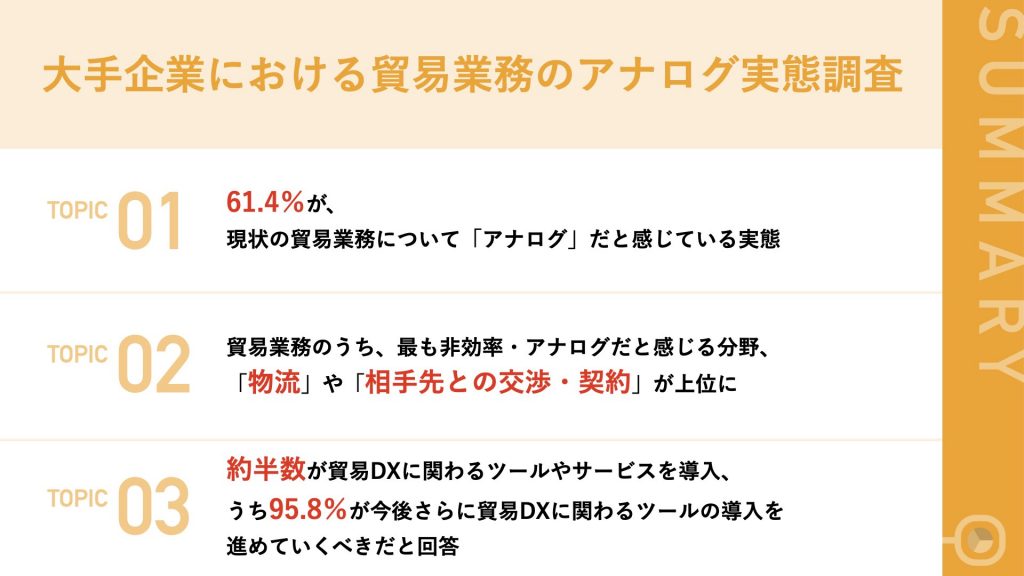
Approximately 60% of respondents described their impression of current trade operations as "analog."
"Q1. What are your impressions of the current state of trade operations?"When asked (n=101),"I think it's very analog" received 14.91 TP3T, and "I think it's somewhat analog" received 46.51 TP3T.The answer was:
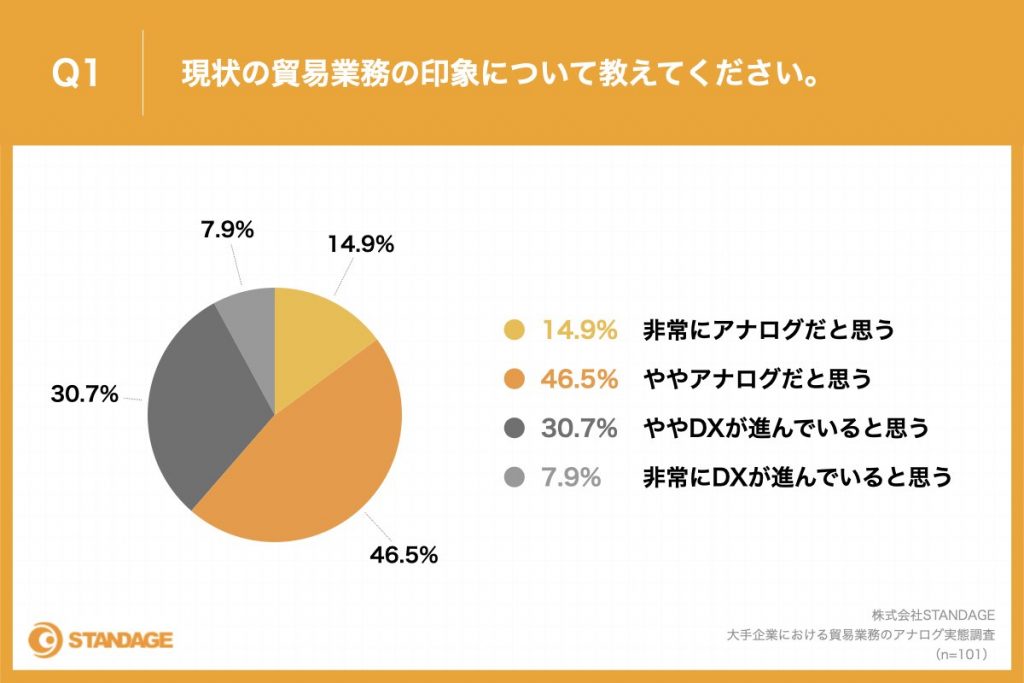
・I think it's very analog: 14.9%
- I think it's somewhat analog: 46.5%
- I think DX is progressing somewhat: 30.7%
I think digital transformation is very advanced: 7.9%
Some people feel that aspects of trade-related work are still analog, such as "negotiations and contracts with trading partners" and "logistics."
For those who answered "I think it's very analog" or "I think it's somewhat analog" in Q1,"Q2. What aspects of trade-related work do you find most inefficient or analog?"When asked (n=66),"Negotiations and contracts with other parties" accounted for 22.71 TP3T, and "Logistics" accounted for 27.31 TP3T.The answer was:
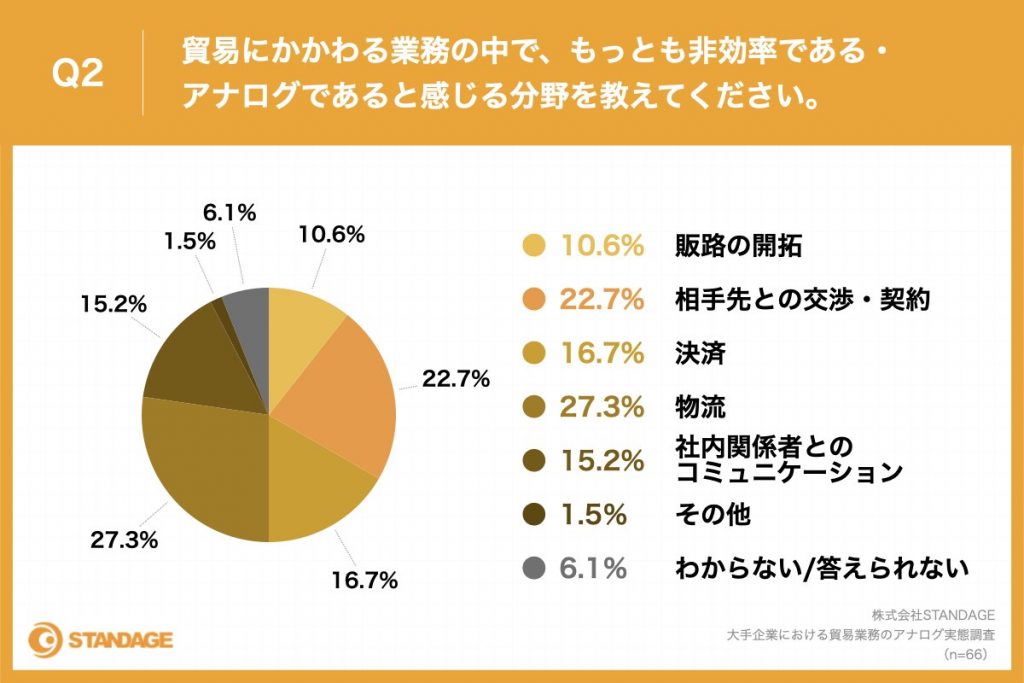
• Development of sales channels: 10.6%
Negotiations and contracts with the other party: 22.7%
Payment: 16.7%
・Logistics: 27.3%
• Communication with internal stakeholders: 15.2%
Other: 1.5%
・I don't know/cannot answer: 6.1%
The most common practical challenge experienced in trade operations was "the emphasis on original documents hinders paperless operations, resulting in poor efficiency," cited by 37.6% of respondents.
"Q3. What are some of the practical challenges you encounter while conducting trade operations? (Multiple answers allowed)"When asked (n=101),"The large number of documents that require originality hinders the progress of paperless operations, resulting in poor work efficiency" received 37.61 TP3T, while "The logistics arrangements and communication with logistics companies are complicated and time-consuming" received 33.71 TP3T.The answer was:
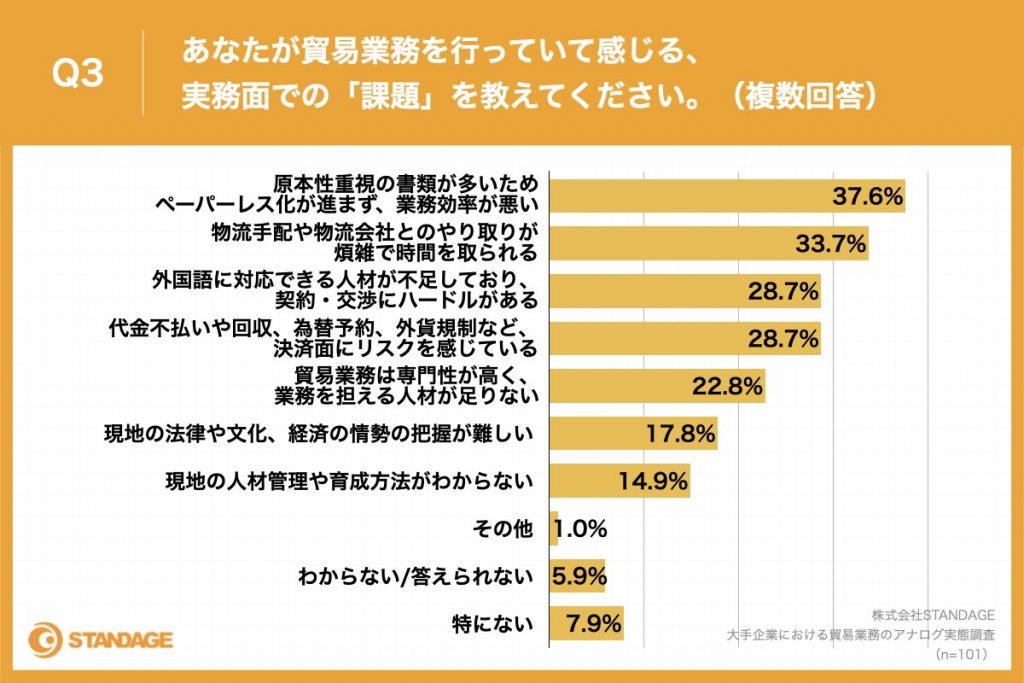
- Due to the large number of documents that prioritize authenticity, paperless operations are not progressing, resulting in poor work efficiency: 37.6%
- Arranging logistics and communicating with logistics companies is complicated and time-consuming: 33.7%
- There is a shortage of personnel who can handle foreign languages, which creates hurdles in contracts and negotiations: 28.7%
- We perceive risks in payment processes, such as non-payment or collection, forward exchange contracts, and foreign exchange restrictions: 28.7%
• Trade operations require a high level of expertise, and there is a shortage of personnel capable of handling these tasks: 22.8%
- It is difficult to grasp the local laws, culture, and economic situation: 17.8%
- I don't know how to manage or train local personnel: 14.9%
Other: 1.0%
・Don't know/can't answer: 5.9%
- Nothing in particular: 7.9%
Practical challenges encountered in trade operations include "differing regulations making it time-consuming to respond" and "a lack of employees familiar with trade procedures such as customs clearance."
For those who answered anything other than "I don't know/cannot answer" or "Nothing in particular" in Q3,"Q4. Please feel free to tell us about any other challenges you feel you have in trade operations besides those you answered in Q3. (Open-ended response)"When asked (n=87),"Regulations differ from country to country, so it takes time to respond," and "We have few employees who are well-versed in trade administration, such as customs clearance."We received 49 responses, including those mentioned above.
<Free answers, excerpts>
・32 years old: Because regulations differ from country to country, it takes time to respond.
・53 years old: There are few employees who are well-versed in trade administration, such as customs clearance.
・59 years old: Because multiple companies are involved, it takes a very long time when problems arise.
65 years old: There is still much room for improvement in promoting efficiency in logistics.
・52 years old: There are many complicated documents. The ship fares and costs are difficult to understand.
49 years old: Difficulty communicating in foreign languages.
・65 years old: The high barrier to learning English in Japan.
93.1% responded that they would like to adopt a payment platform service if one existed that could eliminate all risks and ensure safety and security.
For those who answered in Q3 that they "feel risks in terms of payment, such as non-payment or collection, forward exchange contracts, and foreign exchange restrictions,""Q5. If there was a payment platform service that could eliminate all risks in international trade settlements and enable the safe and secure simultaneous exchange of 'ownership of money' and 'ownership of goods,' would you be interested in adopting it?"When asked (n=29),"Strongly agree" received 37.91 TP3T, and "Somewhat agree" received 55.21 TP3T.The answer was:
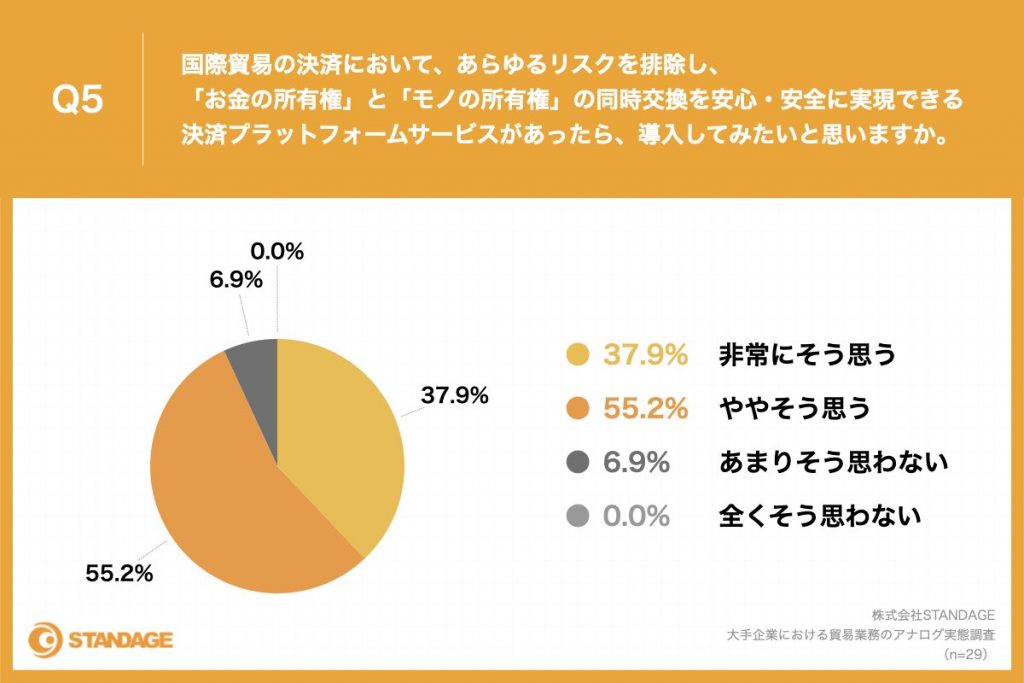
I strongly agree: 37.9%
・Somewhat agree: 55.2%
I don't really think so: 6.9%
・Completely disagree: 0.0%
Approximately 80% of respondents indicated they would like to implement a service that allows them to compare estimated quotes from multiple logistics companies for international trade logistics arrangements, and to handle the ordering process and communication with suppliers.
For those who answered in Q3 that "Arranging logistics and communicating with logistics companies is complicated and time-consuming,""Q6. If there was a service that allowed you to instantly obtain and compare estimated quotes from multiple logistics companies for international trade logistics arrangements, and then proceed with arranging final quotes, placing orders, and communicating with the companies directly, would you be interested in adopting it?"When asked (n=34),"Strongly agree" received 38.21 TP3T, and "Somewhat agree" received 41.21 TP3T.The answer was:
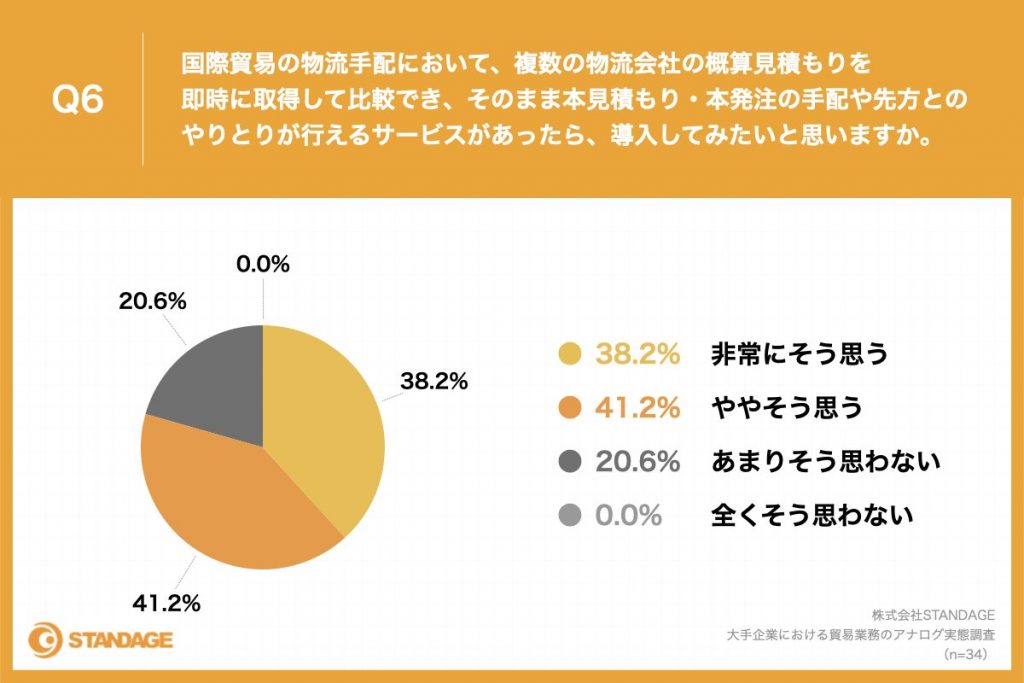
・Strongly agree: 38.2%
・Somewhat agree: 41.2%
I don't really think so: 20.6%
・Completely disagree: 0.0%
In order to streamline trade operations in the future, important things that have been suggested include "simplifying communication with logistics companies" and "systematizing logistics arrangements, or improving existing systems."
"Q7. What do you think is important for streamlining trade operations in the future? (Up to 3 items)"When asked (n=101),"Simplifying communication with logistics companies" scored 37.61 TP3T, "Systematizing logistics arrangements or improving existing systems" scored 36.61 TP3T, and "Digitizing documents (paperless)" scored 34.71 TP3T.The answer was:
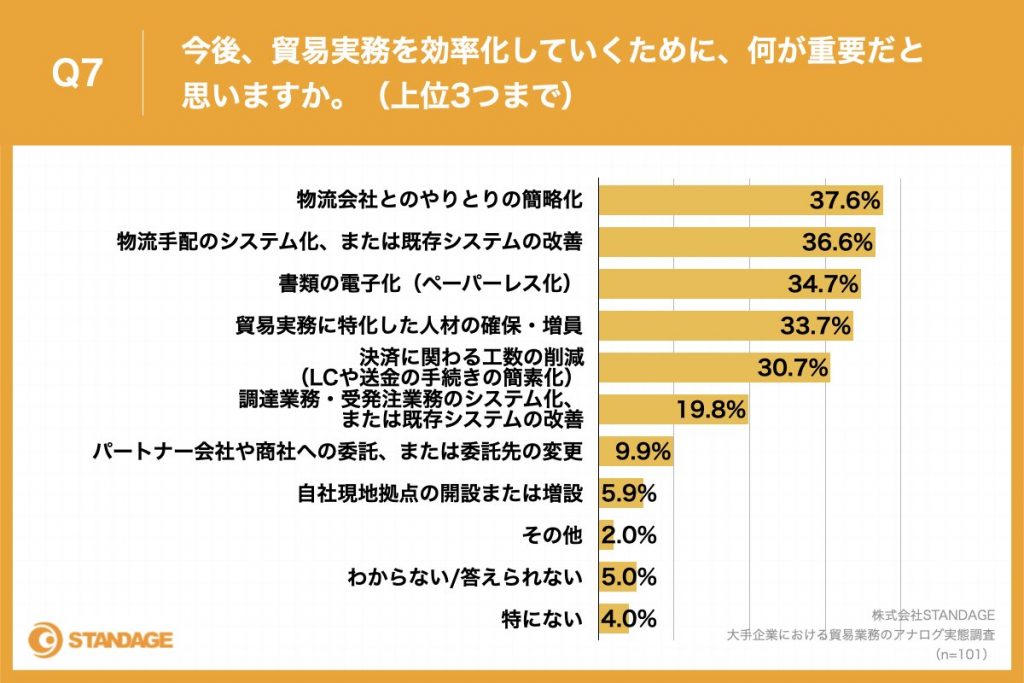
- Simplification of communication with logistics companies: 37.6%
- Systematization of logistics arrangements, or improvement of existing systems: 36.6%
- Digitization of documents (paperless): 34.7%
- Securing and increasing personnel specializing in trade operations: 33.7%
- Reduction of processing time related to settlement (simplification of LC and remittance procedures): 30.7%
- Systematization of procurement and order processing operations, or improvement of existing systems: 19.8%
- Outsourcing to partner companies or trading companies, or changing outsourcing partners: 9.9%
- Establishment or expansion of company-owned local offices: 5.9%
Other: 2.0%
・I don't know/cannot answer: 5.0%
- Nothing in particular: 4.0%
Approximately half of the companies have already implemented tools and services related to trade DX, such as systems for improving operational efficiency.
"Q8. Has your company implemented any tools or services related to trade DX, such as systems for improving operational efficiency?"When asked (n=101),"Yes" resulted in 47.51 TP3T, and "No" resulted in 30.71 TP3T.The answer was:
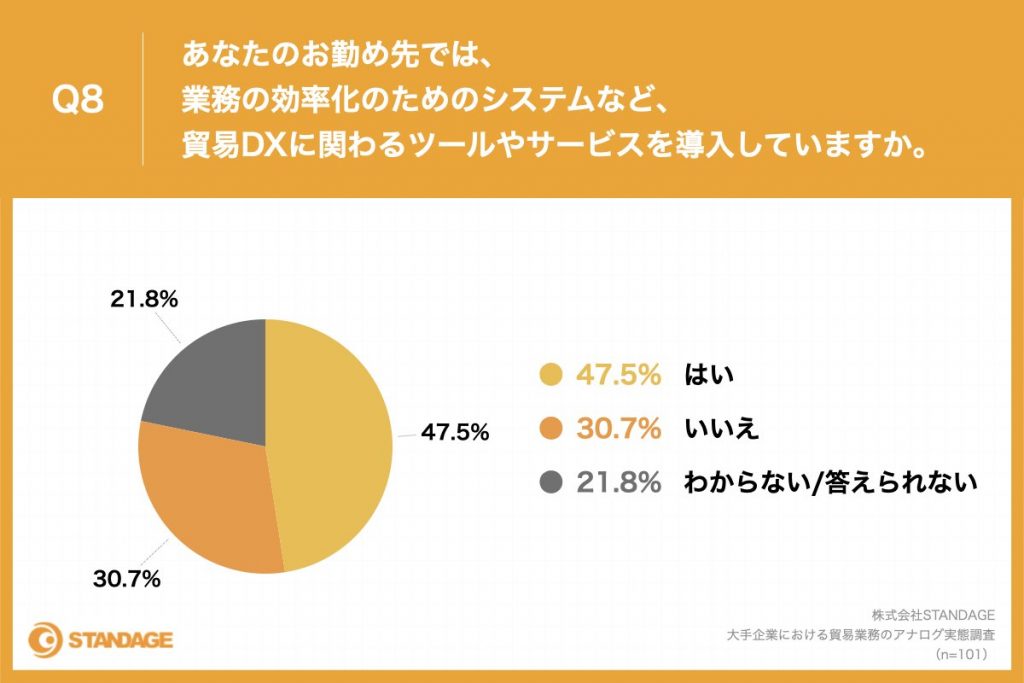
Yes: 47.5%
No: 30.7%
・I don't know/cannot answer: 21.8%
95.8% responded that further progress should be made in introducing tools related to trade DX.
For those who answered "Yes" to Q8,"Q9. Do you think your company should further promote the introduction of trade DX-related tools in the future?"When asked (n=48),"Strongly agree" received 58.31 TP3T, while "Somewhat agree" received 37.51 TP3T.The answer was:
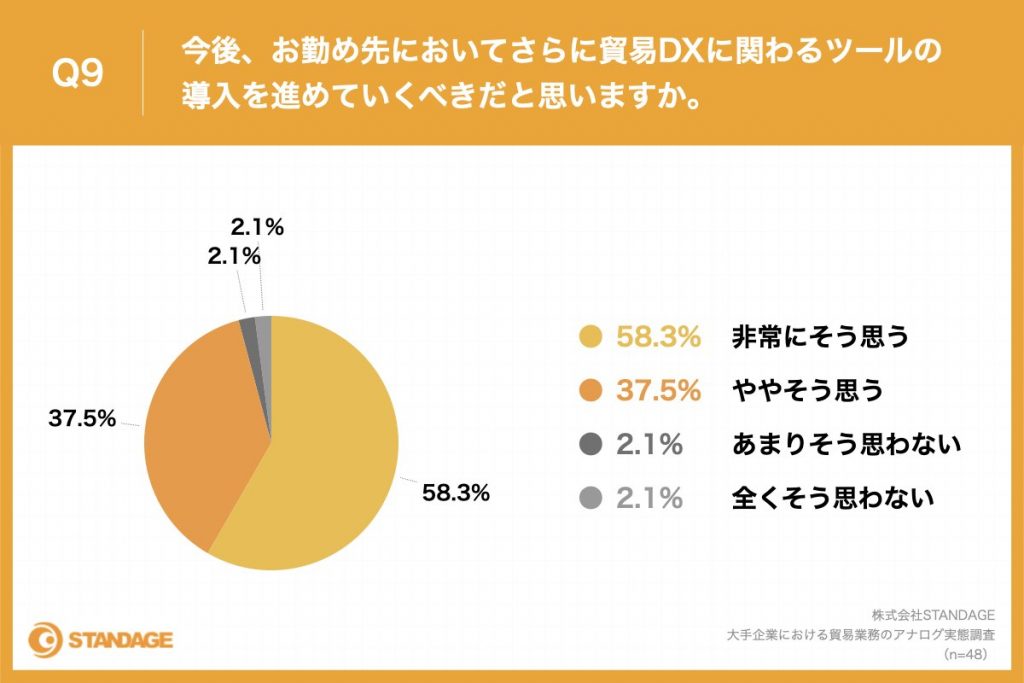
I strongly agree: 58.3%
・Somewhat agree: 37.5%
I don't really think so: 2.1%
・I don't think so at all: 2.1%
The most common reason (54.3%) for further promoting the introduction of tools and services related to trade DX is "because DX can improve the efficiency of communication."
For those who answered "Strongly agree" or "Somewhat agree" in Q9,"Q10. Please tell us why you think we should further promote the introduction of tools and services related to trade DX. (Multiple answers allowed)"When asked (n=46),"Because promoting DX will improve the efficiency of communication" received 54.31 TP3T, "Because increased productivity will broaden the scope of business" received 52.21 TP3T, and "Because increased processing speed will generate greater profits" received 50.01 TP3T.The answer was:
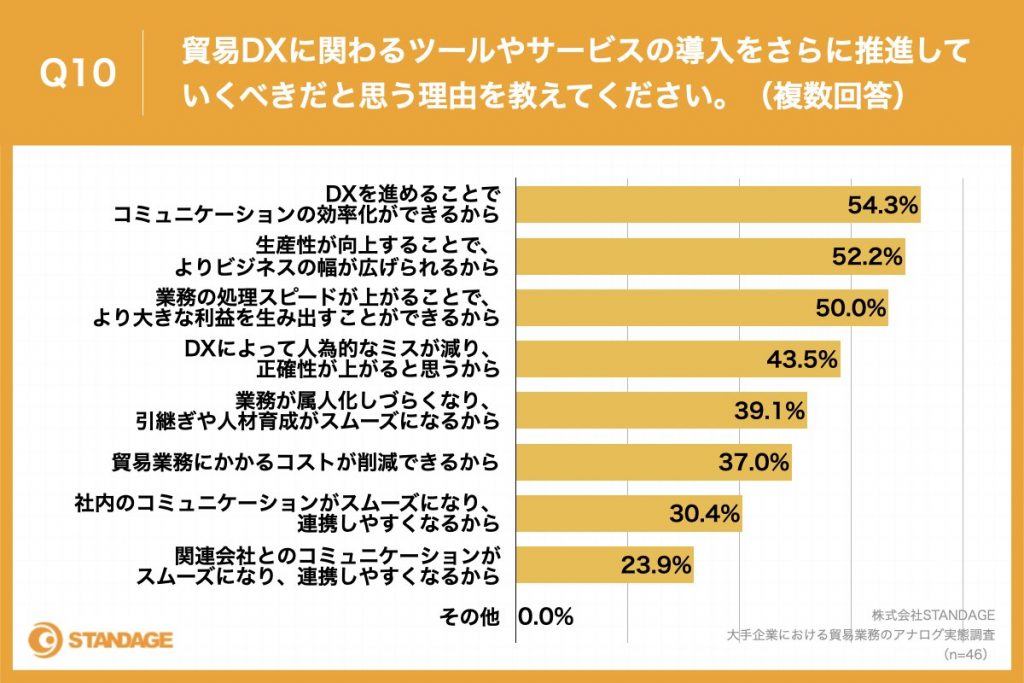
- Because promoting DX will improve the efficiency of communication: 54.3%
- Increased productivity allows for a broader range of business opportunities: 52.2%
- Because increased processing speed will lead to greater profits: 50.0%
・I believe that DX will reduce human error and improve accuracy: 43.5%
- This makes it less likely for tasks to become dependent on specific individuals, leading to smoother handovers and personnel training: 39.1%
- Because it can reduce the costs associated with trade operations: 37.0%
- Because it will make internal communication smoother and collaboration easier: 30.4%
- Because it will facilitate smoother communication and easier collaboration with affiliated companies: 23.9%
・Other: 0.0%
The most common reason given for the lack of progress in adopting trade DX tools was "because existing operations cannot be changed," at 54.8%.
For those who answered "No" in Q8,"Q11. Please tell us the reasons why the introduction of trade DX-related tools is not progressing at your company. (Multiple answers allowed)"When asked (n=31), the response was,"Because we cannot change our existing operations" was cited by 54.81 TP3T, "Because we want to implement it but cannot afford the cost" by 38.71 TP3T, and "Because there are no suitable tools available to solve the problem" by 25.81 TP3T.The answer was:
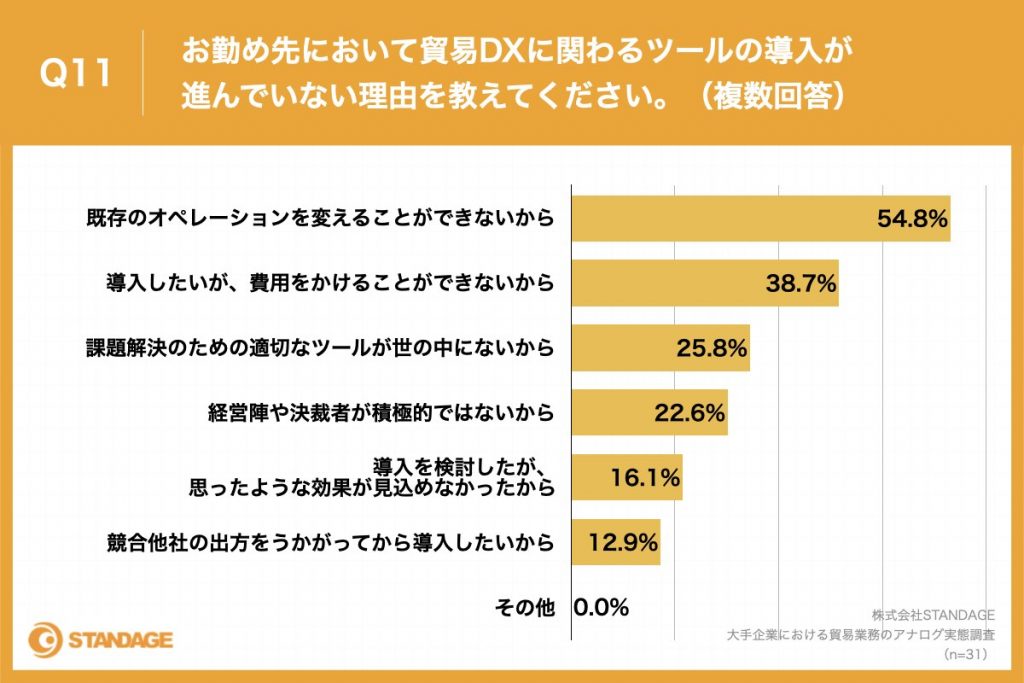
- Because existing operations cannot be changed: 54.8%
- I want to implement it, but I can't afford it: 38.7%
- Because there are no suitable tools available to solve the problem: 25.8%
- Because management and decision-makers are not proactive: 22.6%
- We considered implementing it, but it didn't produce the desired results: 16.1%
- We want to wait and see what our competitors do before implementing it: 12.9%
・Other: 0.0%
Reasons why promoting efficiency in trade operations will become important in the future include "streamlining customs clearance" and "fluctuations in exchange rates and stock prices."
For those who answered "No" in Q8,"Q12. In addition to the answers given in Q11, please feel free to tell us any other reasons why you think promoting efficiency in trade operations will become important in the future. (Open-ended response)"When asked (n=31),"Streamlining customs clearance operations" and "currency and stock price movements"We received 20 responses, including these.
<Free answers, excerpts>
・Age 53: Improving the efficiency of customs clearance operations.
33 years old: Currency and stock price movements.
37 years old: Because the yen will continue to depreciate.
49 years old: Improving operations is an urgent issue as the workforce shrinks.
- Age 65: It is difficult to dispatch personnel to the site who can grasp the entire trade work mindset from start to finish.
・Age 59: Human resource development.
64 years old: It is difficult to create a system that is in line with our company's actual operations.
summary
This time, we conducted a survey on the actual state of analog trade operations in large companies (with 500 or more employees), targeting 101 company employees who are currently involved in or have experience in trade operations at large companies.
Approximately 60% of those in charge feel that "negotiations and contracts with clients" and "logistics" are still analog processes, and practical challenges include "poor work efficiency due to the lack of progress in paperless operations." Many companies also responded that they would like to introduce a platform service that eliminates all risks and ensures safety and security, as well as a service that allows them to instantly obtain and compare estimated quotes from multiple logistics companies, and handle the arrangement of final orders and communication with clients.
To further streamline trade operations, it is anticipated that "simplifying communication with logistics companies," "systematizing logistics arrangements," and "digitizing documents (going paperless)" will be crucial. Nearly half of major companies have already introduced tools and services related to trade DX, such as systems for streamlining operations. For companies that have not yet introduced trade DX tools and services, there are many benefits such as "improved communication efficiency through DX" and "expanded business opportunities due to increased productivity." Therefore, why not consider introducing a service that allows you to conduct trade operations easily and safely?
"DigiTrad" Overview
"DigiTrad" is a comprehensive digital trade service that handles all aspects of trade operations, from matching buyers and sellers to payment, finance, and logistics.
Utilizing this system, we offer a comprehensive trade package service for small and medium-sized businesses, and various systems to meet the needs of large corporations for streamlining their trade operations.
As revealed in this survey, the operations of trade and trading companies tend to be highly specialized and complex, making them highly dependent on individuals. This has made it difficult to change the current operations, which are dependent on people, and it is said that they are lagging behind other industries in terms of digitalization and efficiency improvements.
For large corporations with significant international trade, streamlining trade operations through digital transformation (DX) leads to further business expansion, optimal staffing, and smoother internal and external communication.
On the other hand, it is not realistic for small and medium-sized enterprises (SMEs) to employ trade personnel in-house, and outsourcing to trading companies is also difficult due to the small scale of their transactions. By utilizing "DigiTrad," a trade outsourcing package, SMEs facing these challenges can enter the export market in a way that is manageable in terms of both personnel and costs.
Standage will continue to eliminate the complexities and analog nature of trade practices, aiming to create a society where all companies in Japan, regardless of size, can freely and easily conduct business with overseas partners.
For trade-related inquiries, please contact us here.