
2025.11.28
STANDAGE Co., Ltd. (Minato-ku, Tokyo; President and CEO: Akinori Adachi; hereinafter referred to as STANDAGE), a company that develops and provides digital trade platforms, conducted the 2025 Survey on the Current State of Overseas Market Development in the Food Industry, targeting 108 individuals involved in overseas export and overseas market development operations at companies in Japan that export food products overseas or have experience exporting in the past.
Download this surveyHerefrom.
Survey Overview
*To arrive at a total of 100%, some values have been rounded. Therefore, there may be slight differences from the actual calculated value.
| ≪Terms of use≫
1. Please clearly state "Omakase Trading" as the source of the information. 2 If you use this content on a website, please include the following link as the source. |
■Currently or in the past, the most common export destination was Southeast Asia, at 50.9%.
"Q1. Please tell us which countries/regions your company currently exports to, or has exported to in the past. (Multiple answers allowed)" (n=108)When I asked the question,Southeast Asia (Singapore, Thailand, Vietnam, Malaysia, Indonesia, etc.) received 50.91 TP3T, China (including Hong Kong and Macau) received 47.21 TP3T, and Taiwan received 38.91 TP3T.The answer was:
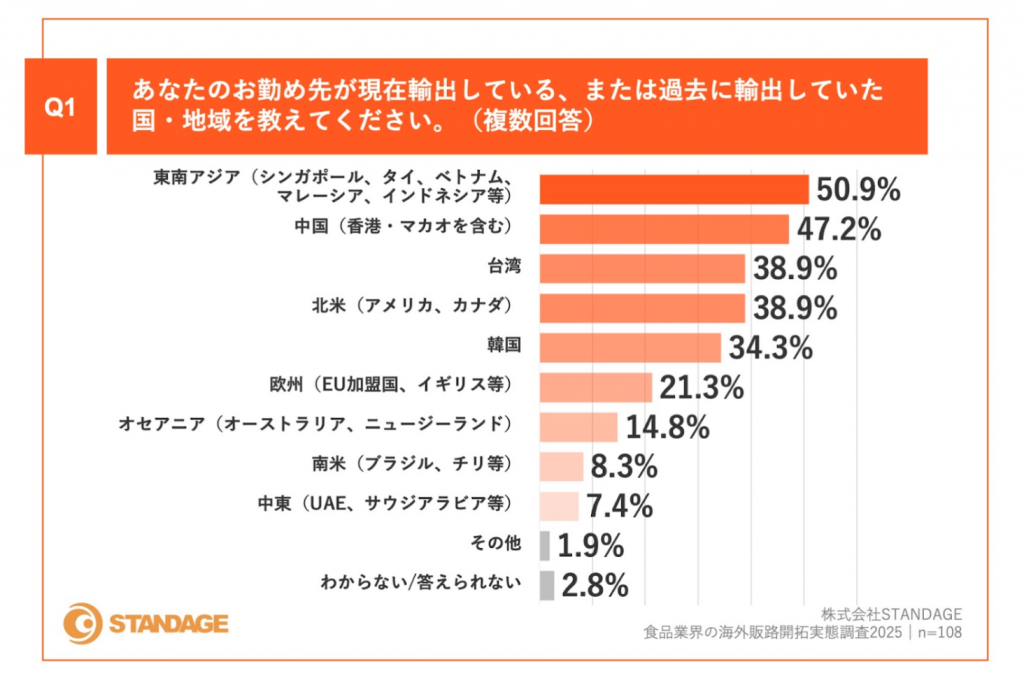
Southeast Asia (Singapore, Thailand, Vietnam, Malaysia, Indonesia, etc.): 50.9%
China (including Hong Kong and Macau): 47.2%
・Taiwan: 38.9%
North America (United States, Canada): 38.9%
• South Korea: 34.31 TP3T
Europe (EU member states, UK, etc.): 21.3%
Oceania (Australia, New Zealand): 14.8%
South America (Brazil, Chile, etc.): 8.3%
Middle East (UAE, Saudi Arabia, etc.): 7.4%
Other: 1.9%
・I don't know/cannot answer: 2.8%
■ Approximately half utilize "exports via trading companies and import/export firms" to develop overseas sales channels.
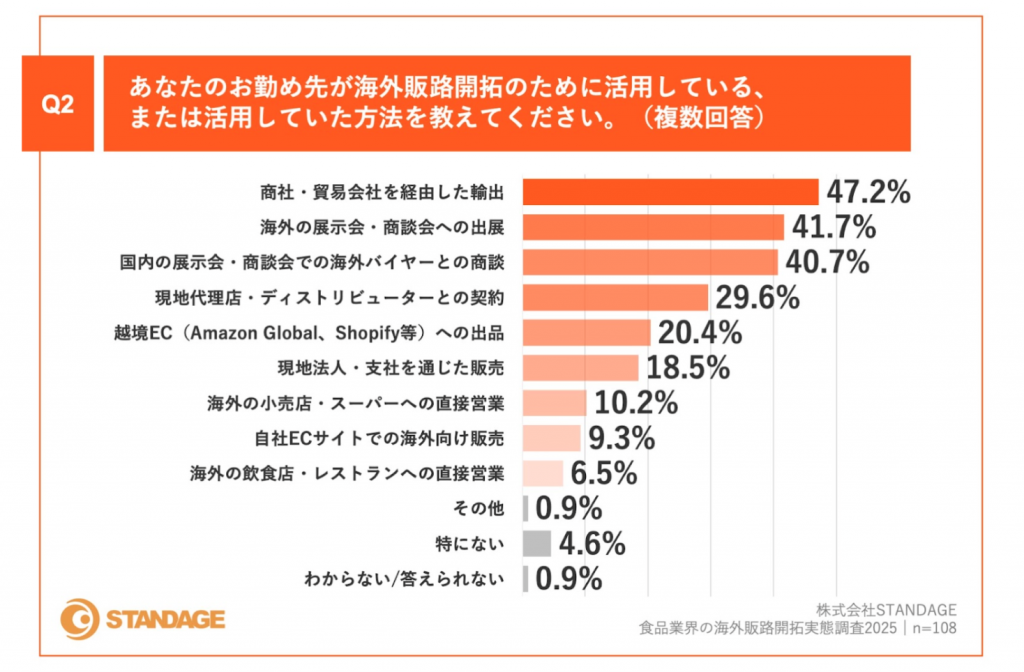
"Q2. Please tell us about the methods your company is currently using or has used to use for developing overseas sales channels. (Multiple answers allowed)"When asked (n=108),"Exports via trading companies" accounted for 47.21 TP3T, "Exhibition at overseas trade shows and business meetings" accounted for 41.71 TP3T, and "Business negotiations with overseas buyers at domestic trade shows and business meetings" accounted for 40.71 TP3T.The answer was:
Exports via trading companies/export firms: 47.2%
- Participation in overseas trade shows and business meetings: 41.7%
・Negotiations with overseas buyers at domestic exhibitions and trade shows: 40.7%
・Contract with local agent/distributor: 29.6%
・Listing products on cross-border e-commerce platforms (Amazon Global, Shopify, etc.): 20.4%
・Sales through local subsidiaries/branches: 18.5%
・Direct sales to overseas retailers and supermarkets: 10.2%
・Overseas sales through our own e-commerce site: 9.3%
・Direct sales to overseas restaurants and eateries: 6.5%
・Other: 0.9%
- Parent company
・Nothing in particular: 4.6%
I don't know/cannot answer: 0.9%
■Top food categories currently exported or previously exported: 1st place: Processed foods (retort pouches, frozen foods, instant foods, etc.), 2nd place: Beverages (soft drinks, tea, coffee, etc. *excluding alcoholic beverages)
"Q3. Please tell us which food categories your company exports or has exported overseas. (Multiple answers allowed)"When asked (n=108),Processed foods (retort pouches, frozen foods, instant foods, etc.) accounted for 33.31 TP3T, beverages (soft drinks, tea, coffee, etc. *excluding alcoholic beverages) accounted for 30.61 TP3T, and alcoholic beverages (sake, shochu, beer, whiskey, etc.) accounted for 26.91 TP3T.The answer was:
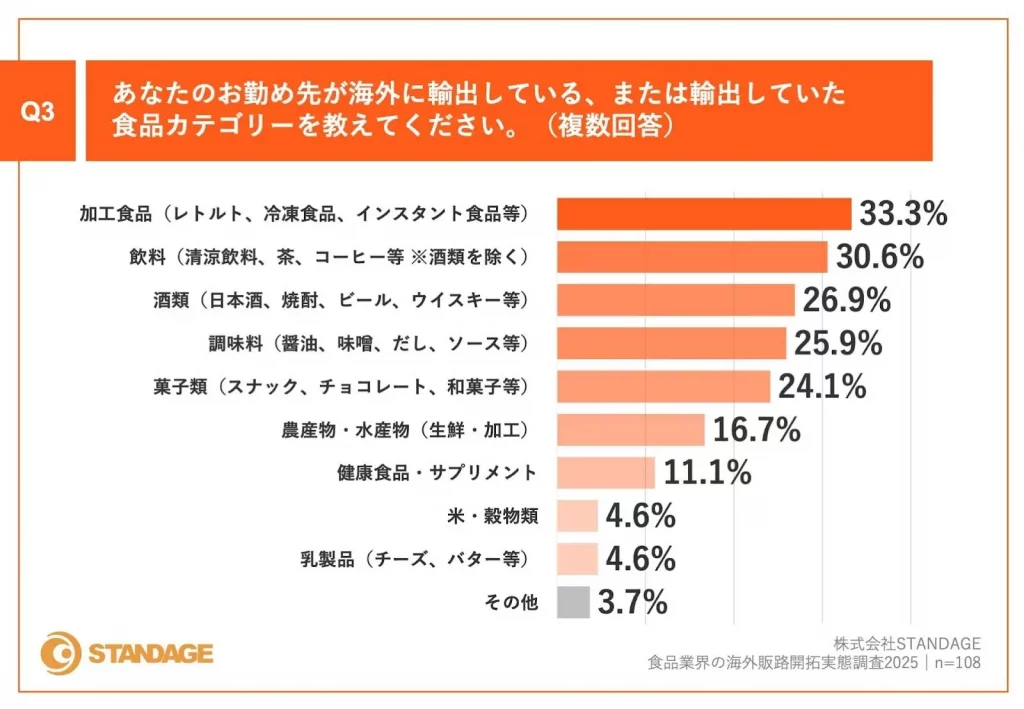
Processed foods (retort foods, frozen foods, instant foods, etc.): 33.3%
• Beverages (soft drinks, tea, coffee, etc. *excluding alcoholic beverages): 30.6%
Alcoholic beverages (sake, shochu, beer, whiskey, etc.): 26.9%
・Seasonings (soy sauce, miso, dashi, sauce, etc.): 25.9%
・Confectionery (snacks, chocolate, Japanese sweets, etc.): 24.1%
・Agricultural and marine products (fresh and processed): 16.7%
・Health foods and supplements: 11.1%
・Rice/grains: 4.6%
・Dairy products (cheese, butter, etc.): 4.6%
・Other: 3.7%
-Food additives
- Seaweed
- Electrical equipment
-Tools
■The top support sources used for developing overseas sales channels were "JETRO (Japan External Trade Organization) support programs" and "support from chambers of commerce and industry."
"Q4. Please tell us about the support measures your company is currently using or has used to use for developing overseas sales channels. (Multiple answers allowed)"When asked (n=108),"JETRO (Japan External Trade Organization) support programs" accounted for 34.31 TP3T, and "Chambers of Commerce and Industry support" accounted for 28.71 TP3T.The answer was:
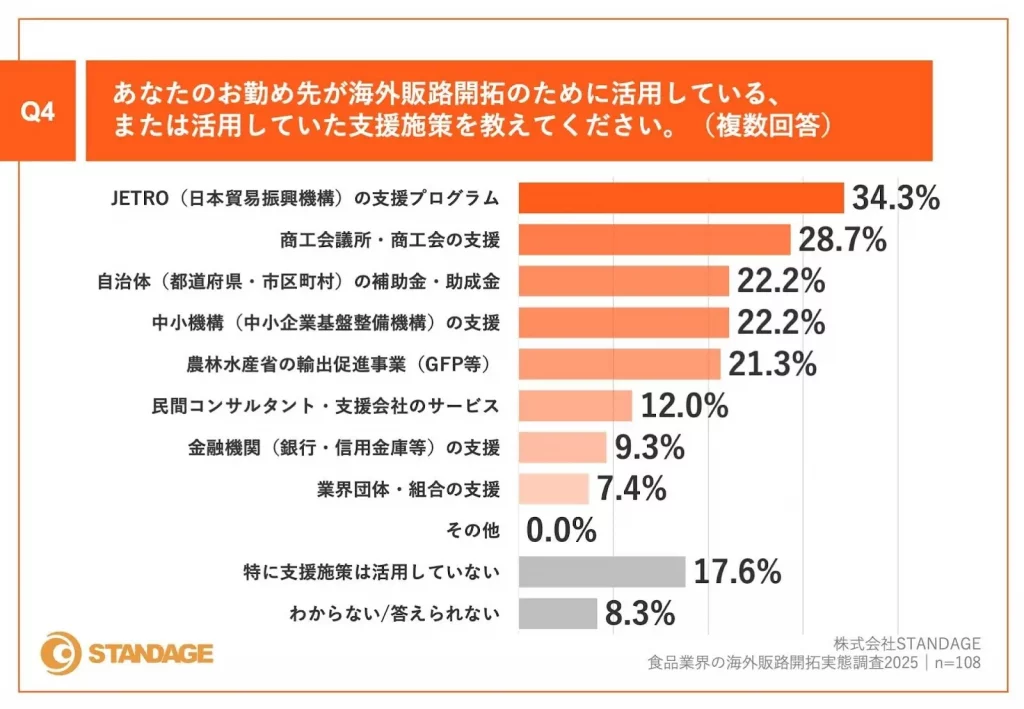
• JETRO (Japan External Trade Organization) support program: 34.3%
Support from Chambers of Commerce and Industry: 28.7%
・Subsidies and grants from local governments (prefectures, cities, towns, and villages): 22.2%
・Support from the Organization for Small & Medium Enterprises and Regional Innovation, JAPAN: 22.2%
・Ministry of Agriculture, Forestry and Fisheries Export Promotion Project (GFP, etc.): 21.3%
・Services from private consulting and support companies: 12.0%
・Support from financial institutions (banks, credit unions, etc.): 9.3%
・Support from industry associations and unions: 7.4%
・Other: 0.0%
・No specific support measures have been utilized: 17.6%
・I don't know/cannot answer: 8.3%
■Challenges in developing overseas sales channels include "high transportation and logistics costs" and "complying with food regulations and import restrictions in destination countries."
"Q5. Please tell us about the challenges your company is currently facing or has faced in developing overseas sales channels. (Multiple answers allowed)"When asked (n=108),"High transportation and logistics costs" was cited by 36.11 TP3T, "Difficulty complying with food and import regulations in exporting countries" by 32.41 TP3T, and "High tariffs making it difficult to maintain price competitiveness" by 28.71 TP3T.The answer was:
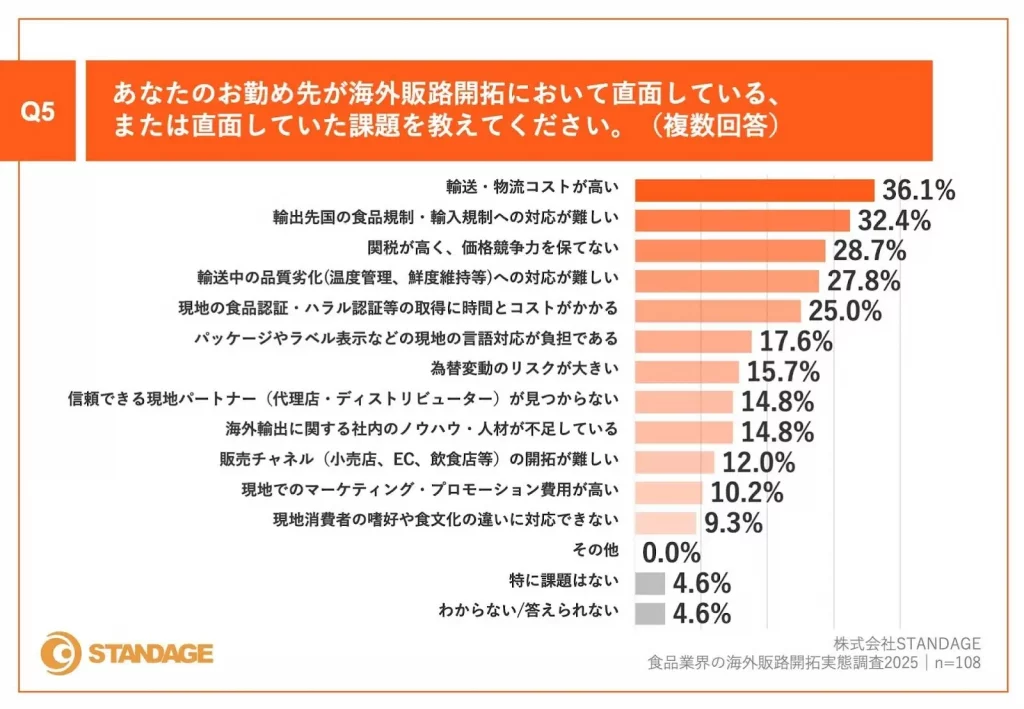
• High transportation and logistics costs: 36.1%
- Difficulty complying with food regulations and import regulations in the importing country: 32.4%
• High tariffs make it difficult to maintain price competitiveness: 28.7%
・Difficulty in addressing quality deterioration during transport (temperature control, freshness maintenance, etc.): 27.8%
・Obtaining local food certifications, halal certifications, etc., is time-consuming and costly: 25.0%
・Local language support for packaging and labeling is a burden: 17.6%
・High risk of exchange rate fluctuations: 15.7%
・Unable to find a reliable local partner (agent/distributor): 14.8%
・We lack the necessary in-house expertise and personnel for overseas exports: 14.8%
・Developing sales channels (retail stores, e-commerce, restaurants, etc.) is difficult: 12.0%
・High local marketing and promotion costs: 10.2%
・Unable to accommodate differences in local consumer preferences and food culture: 9.3%
・Other: 0.0%
・No particular issues: 4.6%
・I don't know/cannot answer: 4.6%
■Approximately half of the companies are implementing strategies to "emphasize trust with local partners and build long-term relationships" when developing overseas sales channels.
"Q6. Please tell us about any efforts your company has made, or has made, in developing overseas sales channels. (Multiple answers allowed)"When asked (n=108),"We value trusting relationships with local partners and aim to build long-term relationships" received 48.11 TP3T, "We continuously participate in trade shows and business meetings to increase brand awareness" received 27.81 TP3T, and "We utilize social media and digital marketing to directly approach local consumers" received 25.91 TP3T.The answer was:
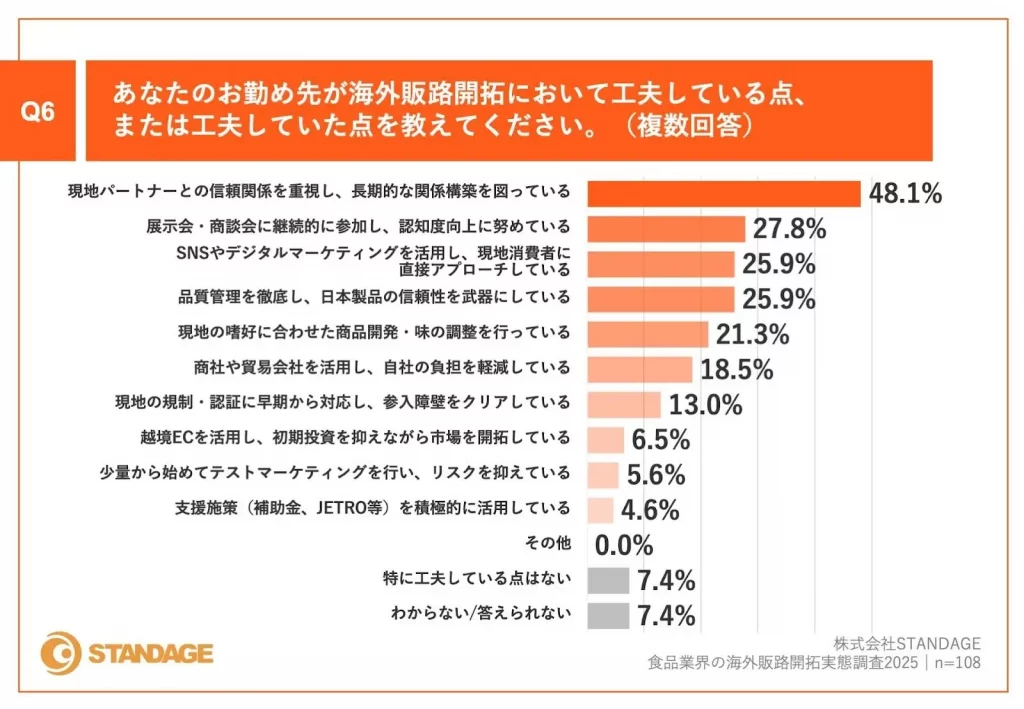
• We value trusting relationships with local partners and aim to build long-term relationships: 48.1%
- We continuously participate in trade shows and business meetings to increase brand awareness: 27.8%
• They are using social media and digital marketing to directly reach local consumers: 25.9%
・We leverage the reliability of Japanese products through thorough quality control: 25.9%
・Product development and flavor adjustments are made to suit local tastes: 21.3%
・By utilizing trading companies and import/export firms, they are reducing their own burden: 18.5%
・By responding early to local regulations and certifications, we have cleared entry barriers: 13.0%
・By utilizing cross-border e-commerce, they are developing the market while keeping initial investment low: 6.5%
・We start small and conduct test marketing to minimize risk: 5.6%
・Actively utilizing support measures (subsidies, JETRO, etc.): 4.6%
・Other: 0.0%
・There's nothing particularly special about it: 7.4%
・I don't know/cannot answer: 7.4%
■ Efforts such as "utilizing local people" and "meeting the client's requests as much as possible" are also being made.
For those who answered anything other than "There's nothing in particular I'm doing differently" or "I don't know/can't answer" in Q6,"Q7. Please feel free to tell us about any other efforts your company has made, or has made, in developing overseas sales channels, besides those you answered in Q6."When asked (n=92),"Utilizing local people" and "Meeting the client's requests as much as possible"We received 59 responses, including those mentioned above.
<Free answers, excerpts>
■ More than 40% responded that they want to strengthen or develop new export markets in Southeast Asia in the future.
"Q8. Which countries/regions does your company plan to strengthen exports to, or develop new ones to, in the future? (You can select up to 3 options.)"When asked (n=108),Southeast Asia (Singapore, Thailand, Vietnam, Malaysia, Indonesia, etc.) has 42.61 TP3T, Taiwan has 32.41 TP3T, and China (including Hong Kong and Macau) has 30.61 TP3T.The answer was:

Southeast Asia (Singapore, Thailand, Vietnam, Malaysia, Indonesia, etc.): 42.6%
・Taiwan: 32.4%
China (including Hong Kong and Macau): 30.6%
・South Korea: 23.1%
・North America (United States, Canada): 22.2%
・Europe (EU member states, UK, etc.): 15.7%
・Oceania (Australia, New Zealand): 9.3%
・Middle East (UAE, Saudi Arabia, etc.): 9.3%
・South America (Brazil, Chile, etc.): 1.9%
・Other: 0.9%
- India
・There are no particular areas I want to strengthen or develop: 1.9%
・I don't know/cannot answer: 7.4%
■ 34.3% requested "support for reducing transportation and logistics costs" to develop overseas sales channels.
"Q9. What kind of support is your company looking for in order to develop overseas sales channels in the future? (You can answer up to 3 items.)"When asked (n=108),"Support for reducing transportation and logistics costs" earned 34.31 TP3T, and "Introduction of local partners (agents/distributors)" earned 31.51 TP3T.The answer was:
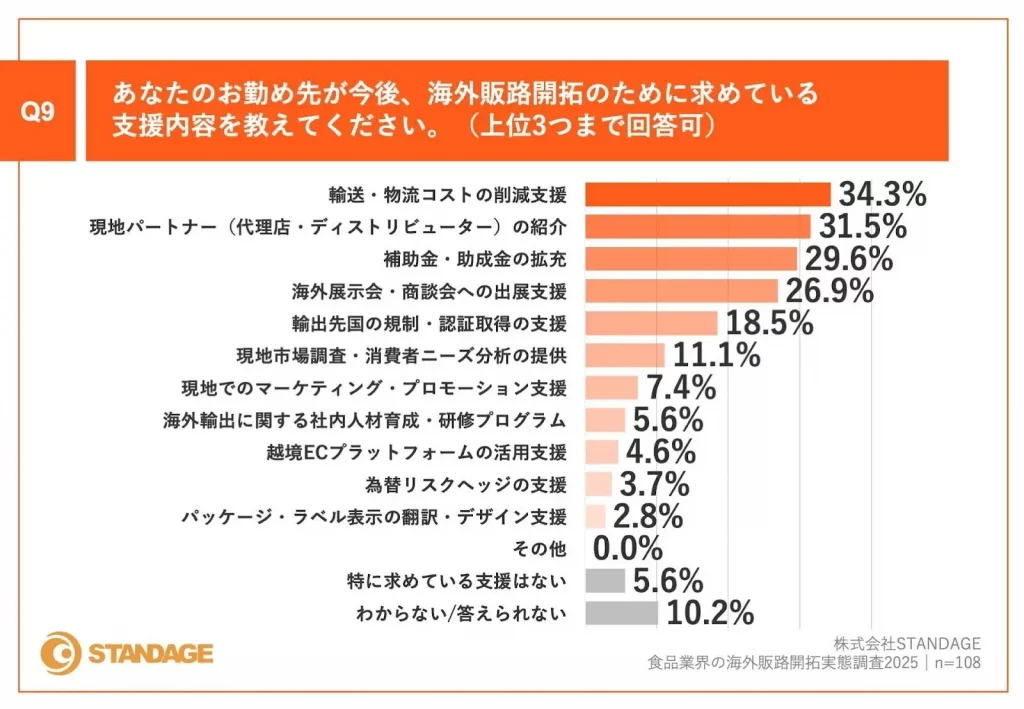
- Support for reducing transportation and logistics costs: 34.3%
- Introduction of local partners (agents/distributors): 31.5%
・Expansion of subsidies and grants: 29.6%
・Support for exhibiting at overseas trade shows and business meetings: 26.9%
・Support for obtaining regulations and certifications in importing countries: 18.5%
・Providing local market research and consumer needs analysis: 11.1%
・Local marketing and promotion support: 7.4%
・Internal personnel development and training program for overseas exports: 5.6%
・Support for utilizing cross-border e-commerce platforms: 4.6%
・Support for currency risk hedging: 3.7%
・Package and label translation and design support: 2.8%
・Other: 0.0%
・No specific support is needed: 5.6%
・I don't know/cannot answer: 10.2%
■ When developing overseas sales channels, approximately half prioritize "market size (expansion of sales volume)."
"Q10. What factors does your company particularly emphasize when developing overseas sales channels? (You can answer up to 3 of the top factors.)"When asked (n=108),"Market size (increase in sales volume)" was 46.31 TP3T, "Profitability (securing profit margins)" was 33.31 TP3T, and "Building long-term relationships (trusting relationships with local partners and customers)" was 27.81 TP3T.The answer was:

Market size (sales volume expansion): 46.3%
Profitability (ensuring profit margin): 33.3%
- Building long-term relationships (building trust with local partners and customers): 27.8%
・Risk management (exchange rates, regulatory changes, country risk, etc.): 26.9%
・Enhanced brand value (awareness and image improvement): 25.9%
・Speed (Early market entry and sales channel establishment): 12.0%
・Quality maintenance (equivalent to quality control in Japan): 9.3%
・Adapting to local needs (product localization): 7.4%
・Sustainability (environmental considerations, SDG compliance, etc.): 6.5%
・Other: 0.0%
・Nothing in particular: 2.8%
・I don't know/cannot answer: 5.6%
■ Summary
This time, we conducted the 2025 Survey on the Current State of Overseas Market Development in the Food Industry, targeting 108 individuals involved in overseas export and market development operations at companies in Japan that export food products overseas or have experience exporting in the past.
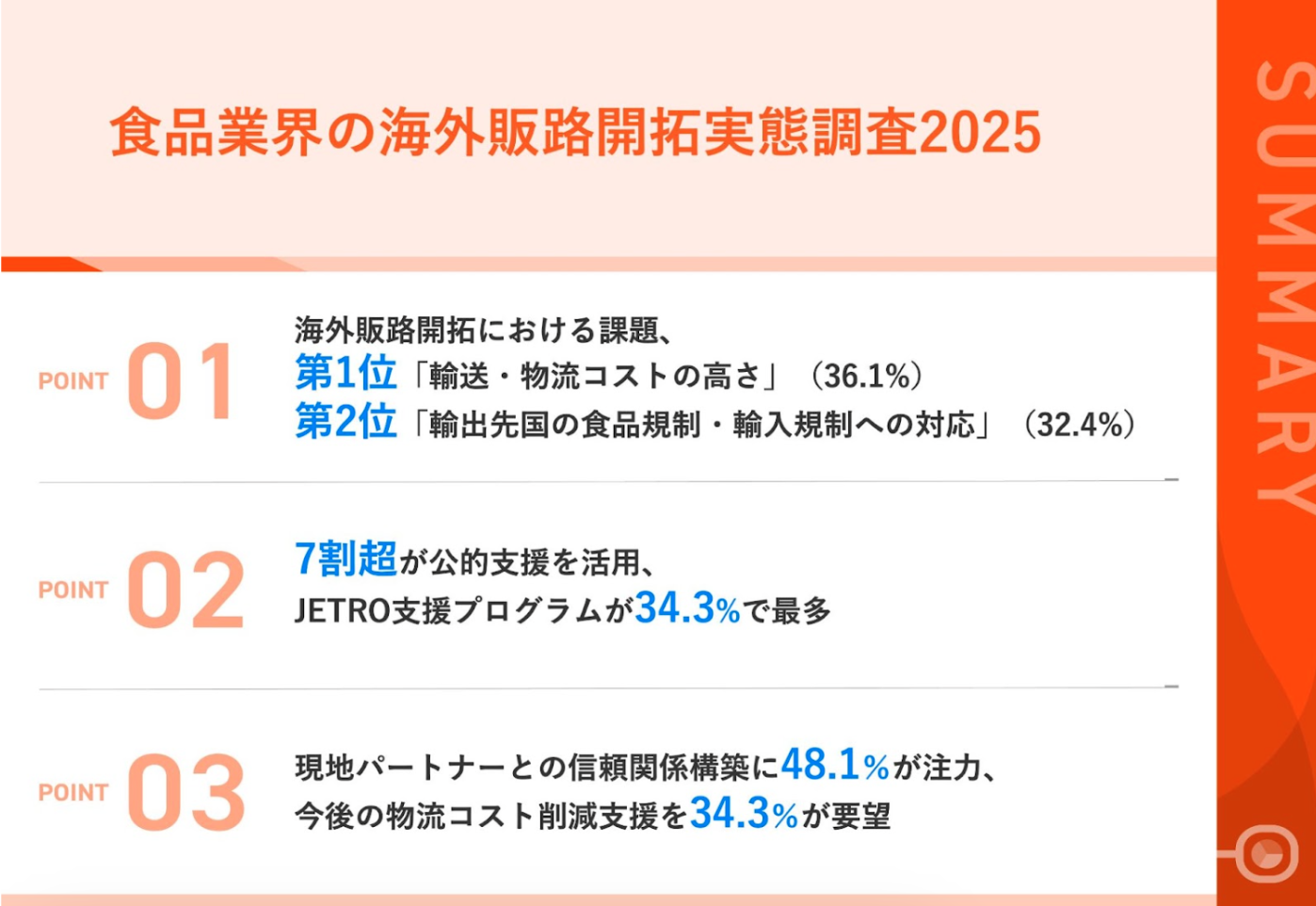
First, the most common destination for current or past exports was Southeast Asia at 50.9%, followed by China (including Hong Kong and Macau) at 47.2%. Regarding methods used to develop overseas sales channels, exporting through trading companies was the most common at 47.2%, followed by participation in overseas trade shows and business meetings at 41.7%. The most common food categories exported were processed foods (retort pouches, frozen foods, instant foods, etc.) at 33.3% and beverages (soft drinks, tea, coffee, etc., excluding alcoholic beverages) at 30.6%. Furthermore, the most frequently utilized support measures were JETRO (Japan External Trade Organization) support programs at 34.3%, followed by support from chambers of commerce at 28.7%. However, 17.6% of companies reported not utilizing any support measures. Regarding challenges in developing overseas sales channels, the top two responses were "high transportation and logistics costs" (36.1%) and "difficulty in complying with food regulations and import regulations in export destination countries" (32.4%). As for strategies being employed, "emphasizing trust with local partners and aiming to build long-term relationships" was cited by approximately half of the respondents (48.1%), and 34.3% requested "support in reducing transportation and logistics costs" as a future support request.
This survey revealed that over 70% of companies utilize some form of public support, and that support measures from organizations such as JETRO and chambers of commerce play a crucial role in initiating overseas expansion. However, in actual overseas expansion, there are challenges that cannot be addressed by existing support measures alone, such as reducing logistics costs (36.1%) and practical compliance with regulations (32.4%). Looking ahead to expansion into Southeast Asia, a growing market, there is a need for hands-on support tailored to the practical needs of companies, such as direct support for reducing logistics costs and effective matching with reliable local partners. Building a practical support platform that combines public support with private sector practical support will be key to realizing the expansion of Japanese food exports.
■Starting your overseas expansion from scratch | Trade agency service "Omakase Trade"
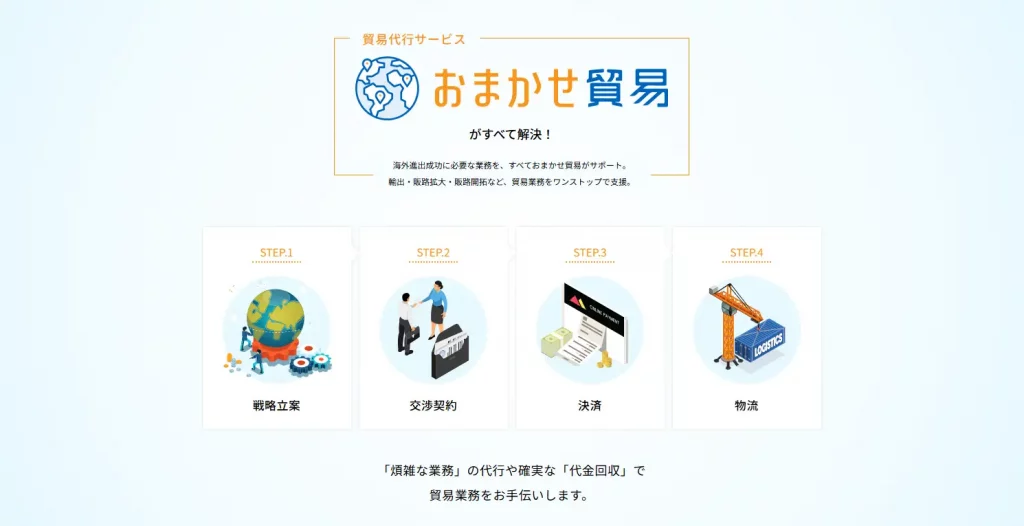
Omakase Trading will support you with all of these tasks necessary for expanding overseas.
We cover all your trade business problems.
With the yen now at an unprecedented low, expanding into overseas markets is a great opportunity for all businesses.
Omakase Trading removes such barriers to overseas expansion and accelerates our customers' business.
We provide one-stop support for your overseas expansion, from overseas market research, to participating in exhibitions, acting as a sales agent, and developing sales channels.
For more information:https://standage.co.jp/service/omakase/
■Company Profile
Company name: STANDAGE Co., Ltd.
Established: March 7, 2017
Representative: Akira Adachi, President and CEO
Address: Sumitomo Fudosan Landmark Plaza 3F, 1-6-7 Shibakoen, Minato-ku, Tokyo 105-0011, Japan
Business Description: Development and provision of a digital trade platform based on blockchain and AI technologies.
[Contact for inquiries regarding this matter]
STANDAGE Co., Ltd. Marketing Department, Iizuka
TEL: 03-6435-3371 E-mail: info@standage.co.jp
For trade-related inquiries, please contact us here.