
2026.3.9
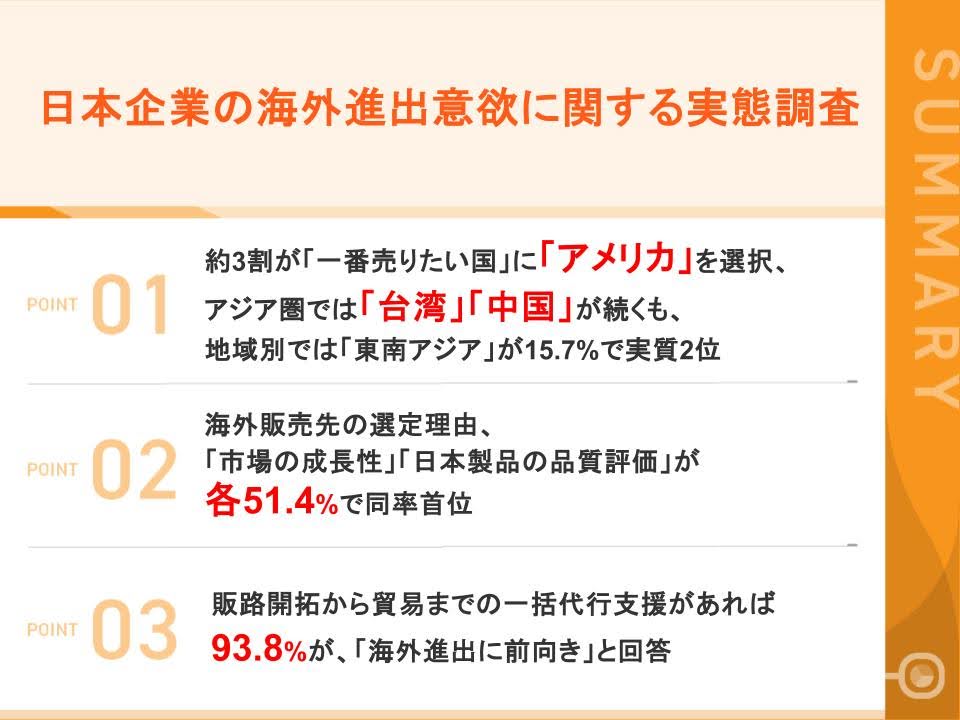
STANDAGE Co., Ltd. (Minato-ku, Tokyo; President and CEO: Akinori Adachi; hereinafter referred to as STANDAGE), a company that develops and provides digital trade platforms, conducted a survey on the actual state of Japanese companies' willingness to expand overseas, targeting 109 executives and overseas business managers of Japanese companies interested in selling their products abroad.
Download this surveyHerefrom.
*The composition ratios are rounded to the first decimal place, so the total may not necessarily add up to 100.
| ≪Terms of use≫
1. Please clearly state "Omakase Trading" as the source of the information. 2 If you use this content on a website, please include the following link as the source. |
"Q1. Regardless of whether you have export experience or know-how, please tell us which country or region you would most like to sell your company's products to right now."When asked (n=109),"United States" has 29.41 TP3T, and "Taiwan" has 16.51 TP3T.The answer was:
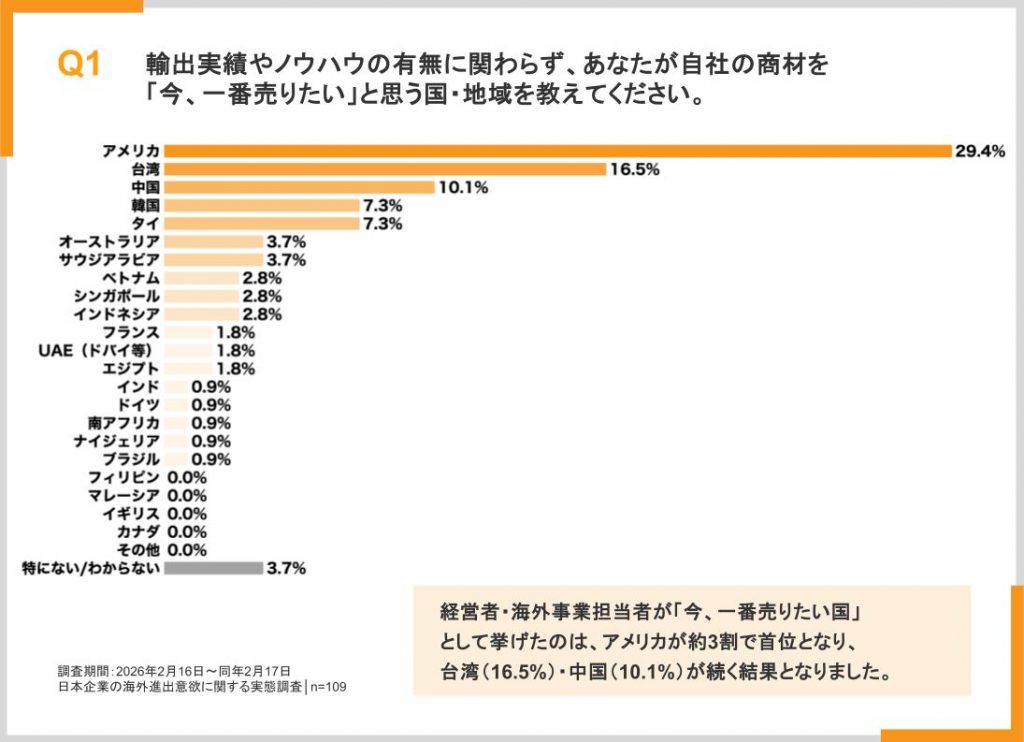
・United States: 29.4%
・Taiwan: 16.5%
・China: 10.1%
• South Korea: 7.3%
Thailand: 7.3%
Australia: 3.7%
Saudi Arabia: 3.7%
Vietnam: 2.8%
Singapore: 2.8%
Indonesia: 2.8%
France: 1.8%
UAE (Dubai, etc.): 1.8%
Egypt: 1.8%
India: 0.9%
Germany: 0.9%
South Africa: 0.9%
Nigeria: 0.9%
Brazil: 0.9%
Philippines: 0.0%
Malaysia: 0.0%
• United Kingdom: 0.0%
Canada: 0.0%
・Other: 0.0%
- Nothing in particular/Don't know: 3.7%
"Q2. For those who answered something other than "Nothing in particular/Don't know" in Q1, please tell us why you would most like to sell the country/region you selected in Q1. (Multiple answers allowed)"When asked (n=105),"Because the market is growing and demand is expected to expand" received 51.41 TP3T, "Because the market highly values the quality of Japanese products" received 51.41 TP3T, and "Because the people have a pro-Japanese character and Japanese products are easily accepted" received 35.21 TP3T.The answer was:
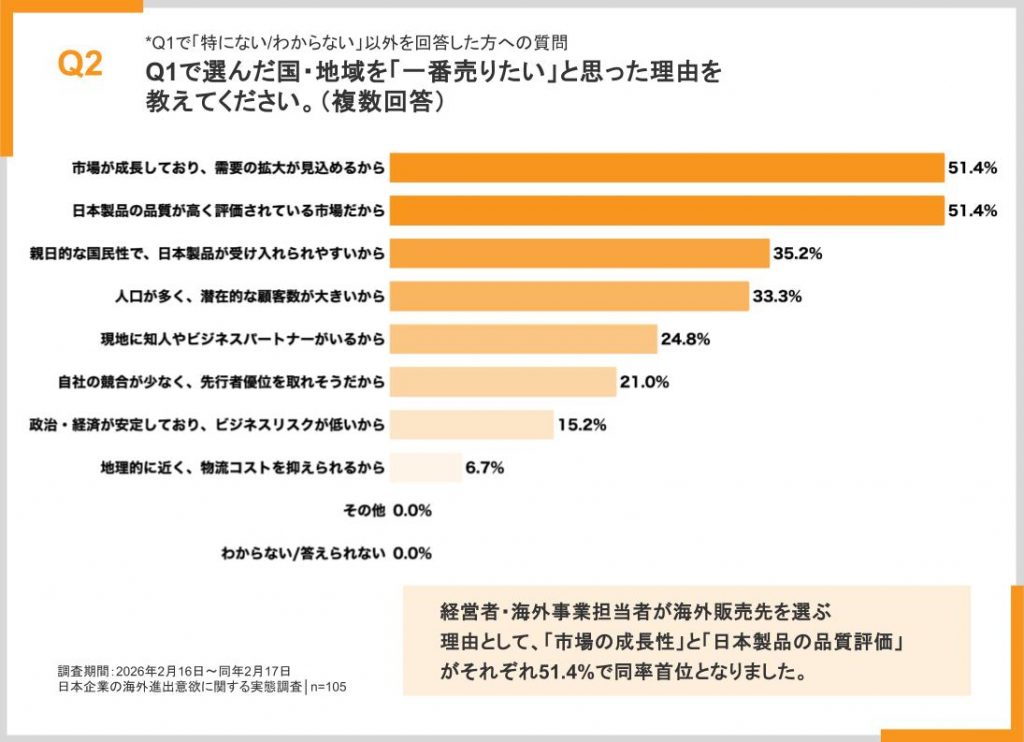
• Because the market is growing and demand is expected to expand: 51.4%
Because it's a market where the quality of Japanese products is highly valued: 51.4%
- Because of their pro-Japanese national character, Japanese products are easily accepted: 35.2%
• Because of the large population and large potential customer base: 33.3%
- Because I have acquaintances or business partners in the area: 24.8%
- Because there are few competitors and we can gain a first-mover advantage: 21.0%
• Because the political and economic situation is stable and business risks are low: 15.2%
- Because it is geographically close and logistics costs can be kept down: 6.7%
・Other: 0.0%
・Don't know/can't answer: 0.0%
"Q3. For those who answered something other than "Nothing in particular/Don't know" in Q1, to what extent can you imagine your company's products actually selling in the country/region you selected in Q1?"When asked (n=105),37.11 TP3T answered "I can imagine specific customer profiles and sales scenarios," while 43.81 TP3T answered "I can imagine them to some extent."The answer was:
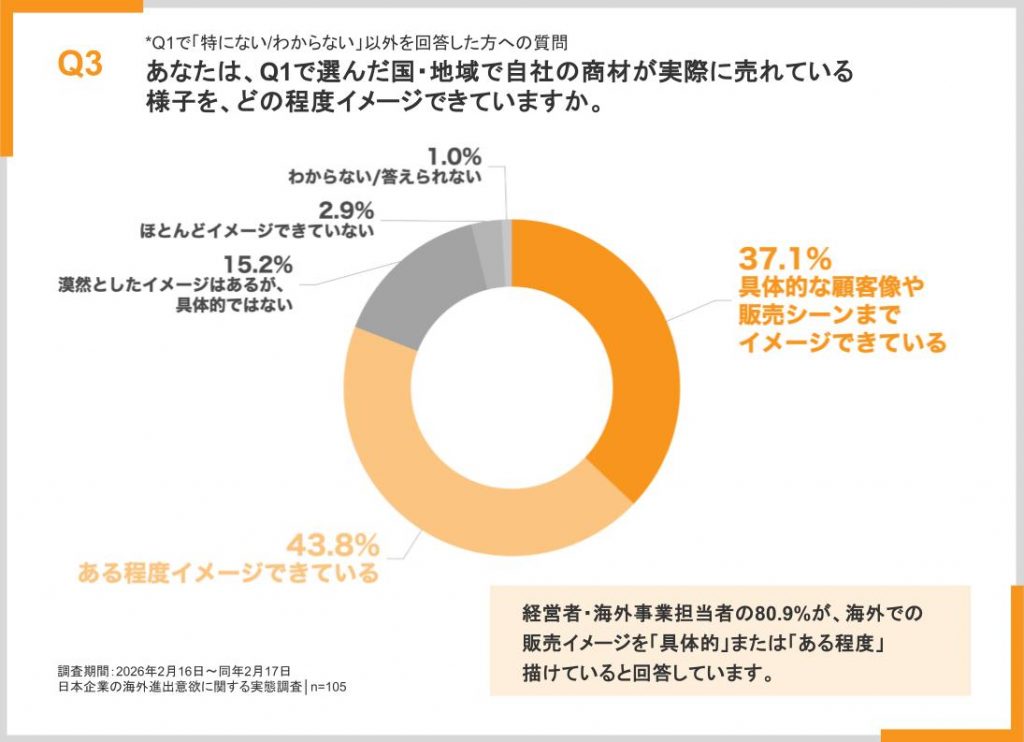
- I can visualize specific customer profiles and sales scenarios: 37.1%
- I have a general idea: 43.8%
- I have a vague image, but it's not specific: 15.2%
- I can barely picture it: 2.9%
・I don't know/cannot answer: 1.0%
"Q4. Does your company currently engage in overseas sales (exports)?"When asked (n=109),"We regularly conduct overseas sales" received 70.61 TP3T, while "We have conducted overseas sales in the past, but do not currently" received 25.71 TP3T.The answer was:
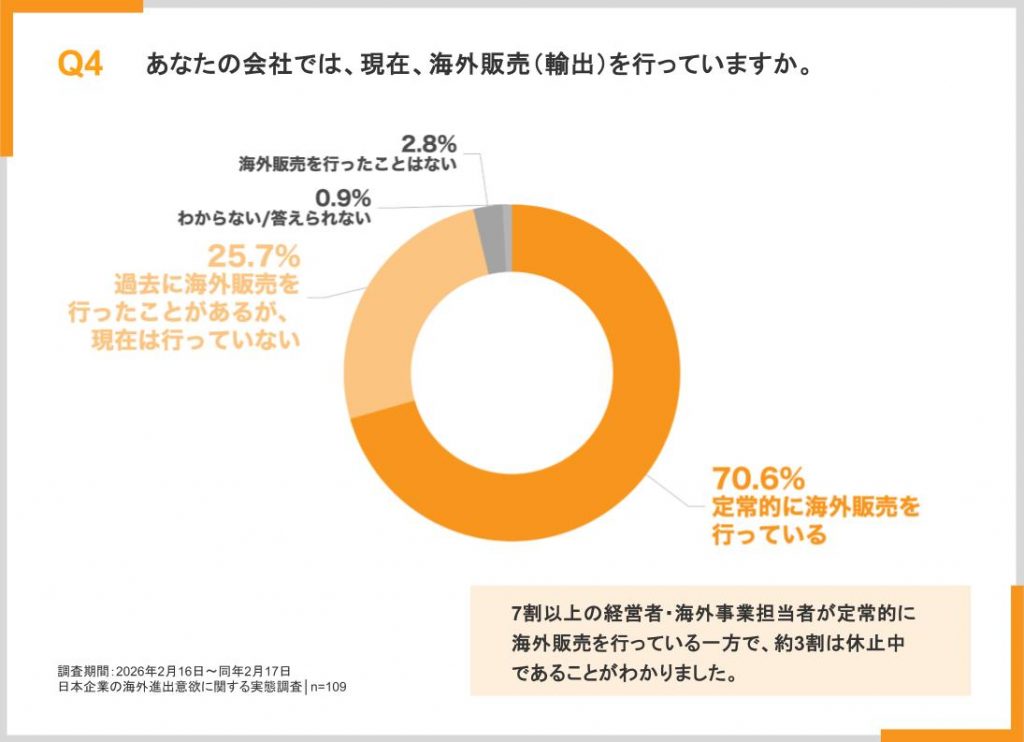
• Regularly sells overseas: 70.6%
- Previously sold overseas, but not currently: 25.7%
- Never sold overseas: 2.8%
・I don't know/cannot answer: 0.9%
"Q5. For those who answered in Q4 'I have sold overseas in the past, but not currently' or 'I have never sold overseas,' please tell us the reasons why you have not yet ventured into overseas sales. (Multiple answers allowed)"When asked (n=31),"Because we don't know how to arrange logistics (international shipping, packaging, etc.)" was cited by 32.3%, "Because we have no contact with overseas business partners or buyers" was cited by 32.3%, and "Because local laws and regulations and import procedures are complicated" was cited by 32.3%.The answer was:
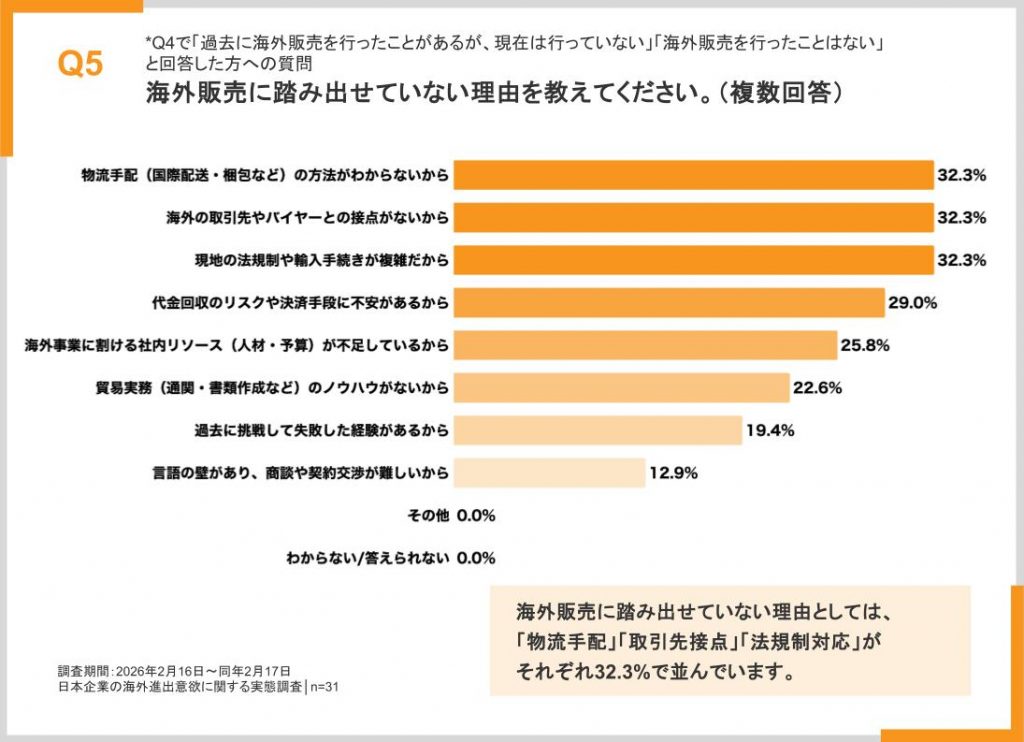
- Because I don't know how to arrange logistics (international shipping, packaging, etc.): 32.3%
- Because we have no contact with overseas business partners or buyers: 32.3%
- Because local laws and import procedures are complex: 32.3%
- Because of concerns about the risk of payment collection and payment methods: 29.0%
- Because we lack sufficient internal resources (personnel and budget) to allocate to overseas business: 25.8%
- Lack of expertise in trade practices (customs clearance, document preparation, etc.): 22.6%
- Because I have tried and failed in the past: 19.4%
- Because of language barriers, business negotiations and contract negotiations are difficult: 12.9%
・Other: 0.0%
・Don't know/can't answer: 0.0%
"Q6. For those who answered something other than "I don't know/cannot answer" in Q5, please feel free to tell us any other reasons why you haven't ventured into overseas sales besides the ones you mentioned in Q5."When asked (n=31),11I was able to get the answer.
<Free answers, excerpts>
・There are no sales channels.
There is a risk.
・Not anymore.
"Q7. This question is for those who did not answer "We regularly conduct overseas sales" in Q4. If there was a service that handled all aspects of trade operations, from market development to delivery and payment collection, how positive would you be about expanding into overseas sales?"When asked (n=32),"We want to try expanding as soon as possible" received 18.81 TP3T, while "We want to consider expanding within one year" received 46.91 TP3T.The answer was:
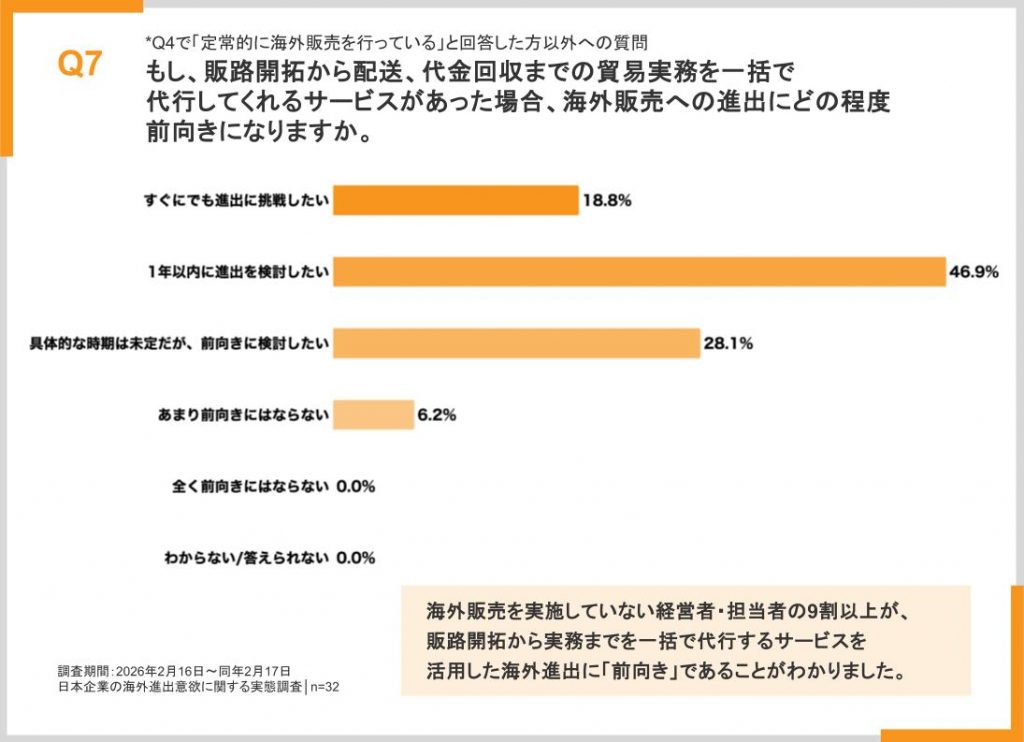
I want to try expanding into the market as soon as possible: 18.8%
We would like to consider expanding within one year: 46.9%
- The specific timing is yet to be determined, but we would like to consider it positively: 28.1%
- Not very positive: 6.2%
- Not positive at all: 0.0%
・Don't know/can't answer: 0.0%
"Q8. For those who answered in Q7 'I want to try expanding immediately,' 'I want to consider expanding within a year,' or 'The specific timing is undecided, but I want to consider it positively,' please tell us what you particularly expect from a service that handles all aspects of trade operations for you. (Multiple answers allowed)"When asked (n=30),"Preparation of necessary export documents and assistance with customs clearance procedures" was 56.71 TP3T, "Matching with overseas buyers and providing business negotiation opportunities" was 50.01 TP3T, and "Arrangement of international logistics (packaging and delivery)" was 50.01 TP3T.The answer was:
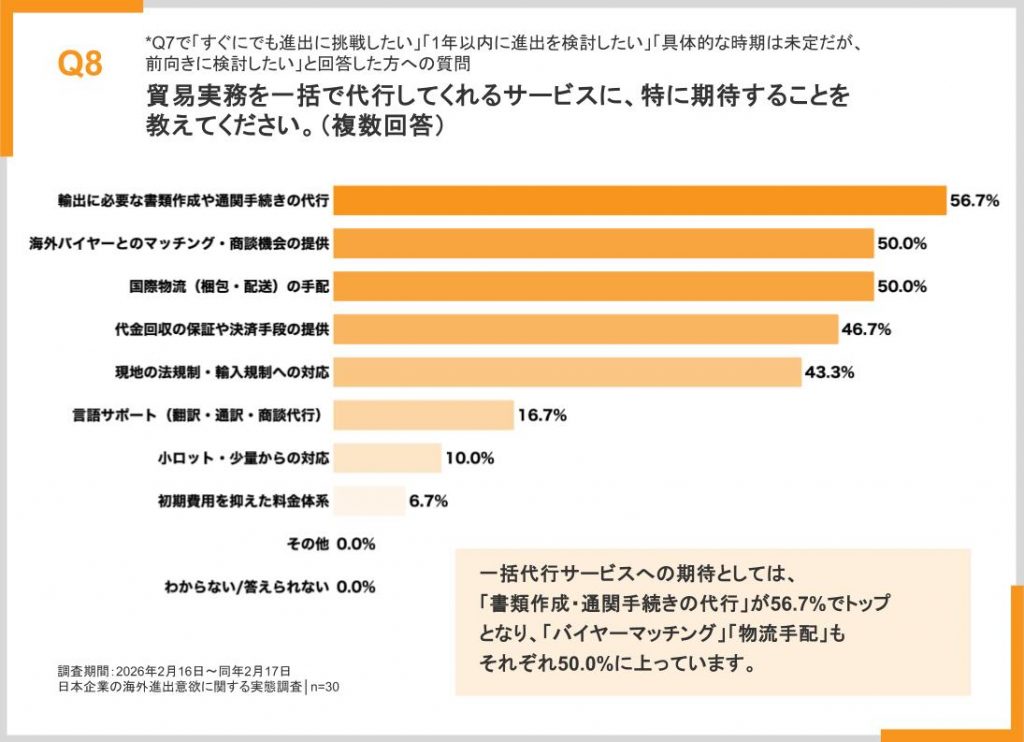
- Preparation of necessary export documents and assistance with customs clearance procedures: 56.7%
- Providing matching and business negotiation opportunities with overseas buyers: 50.0%
• Arrangement of international logistics (packaging and delivery): 50.0%
• Guarantee of payment collection and provision of payment methods: 46.7%
- Compliance with local laws and import regulations: 43.3%
• Language support (translation, interpretation, business negotiation): 16.7%
- We can handle small lots and small quantities: 10.0%
• Pricing structure with reduced initial costs: 6.7%
・Other: 0.0%
・Don't know/can't answer: 0.0%
"Q9. What are your greatest expectations regarding the sale of your company's products overseas? (Multiple answers allowed)"When asked (n=109),"Risk diversification against the contraction of the domestic market" was 51.41 TP3T, "Expansion of sales and profits" was 47.71 TP3T, and "Increased international recognition of our brand" was 34.91 TP3T.The answer was:
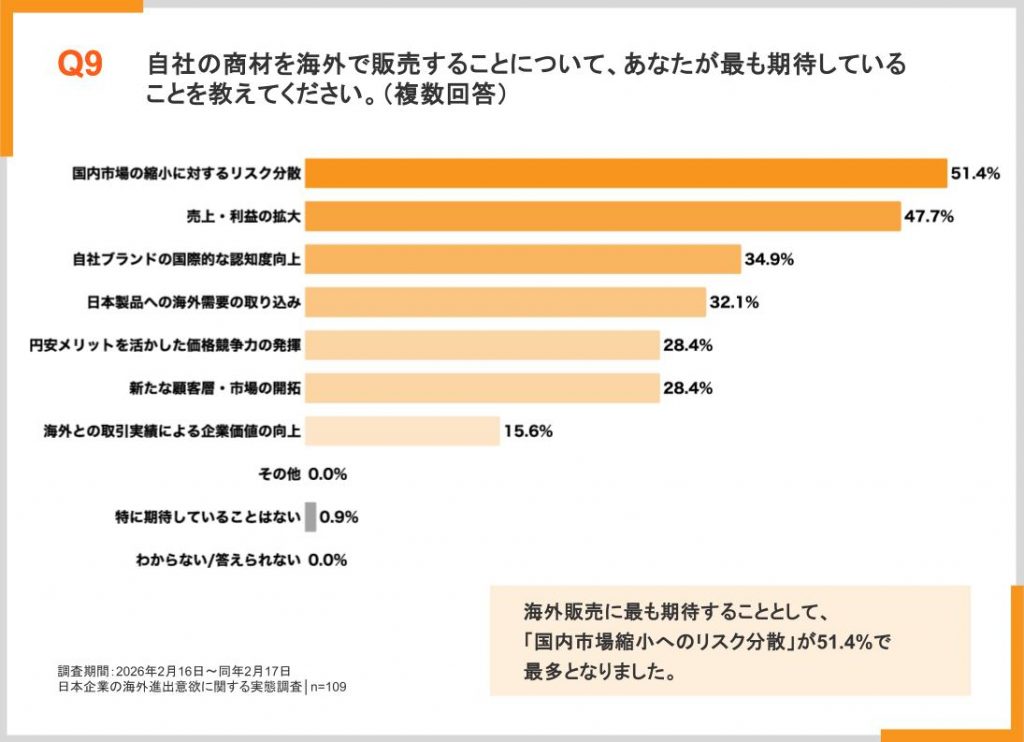
• Risk diversification against the contraction of the domestic market: 51.4%
• Increased sales and profits: 47.7%
- Increased international brand awareness: 34.9%
- Capturing overseas demand for Japanese products: 32.1%
- Leveraging the benefits of a weaker yen to demonstrate price competitiveness: 28.4%
• Development of new customer segments and markets: 28.4%
- Increased corporate value due to overseas business transactions: 15.6%
・Other: 0.0%
- I don't have any particular expectations: 0.9%
・Don't know/can't answer: 0.0%
"Q10. For those who answered something other than "I don't know/cannot answer" or "I don't have any particular expectations" in Q9, please feel free to tell us if there is anything else you expect from overseas sales besides what you answered in Q9."When asked (n=108),40I was able to get the answer.
<Free answers, excerpts>
- Entry into the hyperscaler market.
- Cost reduction and market share expansion through the establishment of local development, and optimization of localization.
- Communication with overseas customers.
Because I feel the Japanese market is shrinking.
- Improve brand image.
This time, we conducted a survey on the actual state of Japanese companies' willingness to expand overseas, targeting 109 executives and overseas business managers of Japanese companies interested in selling their products abroad. The results showed that the United States was the most popular country for sales at about 30%, and that about 90% would be positive about expanding overseas if comprehensive support for sales channel development and trade was provided.
First, the top country where companies want to sell their products was the United States (29.41 TP3T), followed by Taiwan (16.51 TP3T) and China (10.11 TP3T). On the other hand, when Southeast Asian countries such as Thailand (7.31 TP3T) and Vietnam (2.81 TP3T) are combined, the total reaches 15.71 TP3T, highlighting the significant presence of these countries in Asia. The most common reasons for selecting a sales destination were "market growth potential" and "reputation of Japanese product quality," both tied for first place at 51.41 TP3T. Regarding sales images, 80.91 TP3T responded that they had "concrete" or "somewhat" images. Currently, 70.61 TP3T are conducting overseas sales on a regular basis, while companies that have not yet started or have suspended overseas sales cited "logistics arrangements," "contacting business partners," and "compliance with legal regulations" as reasons for not taking the plunge, each at 32.31 TP3T. 93.81 TP3T responded positively to the idea of comprehensive outsourcing support covering everything from market development to delivery, with "document creation and customs clearance procedures" (56.71 TP3T) being the most anticipated function. Regarding expectations for overseas sales, "diversification of risk due to the shrinking domestic market" (51.41 TP3T) outnumbered "expansion of sales and profits" (47.71 TP3T).
This survey revealed that while Japanese companies have a high level of willingness to sell overseas, the complexity of procedures and securing sales channels involved in overseas expansion, such as logistics arrangements, compliance with legal regulations, and building relationships with business partners, are acting as barriers to entry. Amidst growing awareness of the need for risk diversification in anticipation of a shrinking domestic market, developing services that comprehensively support everything from sales channel development to practical operations will be key to bridging the gap between willingness and action.
Download this surveyHerefrom.
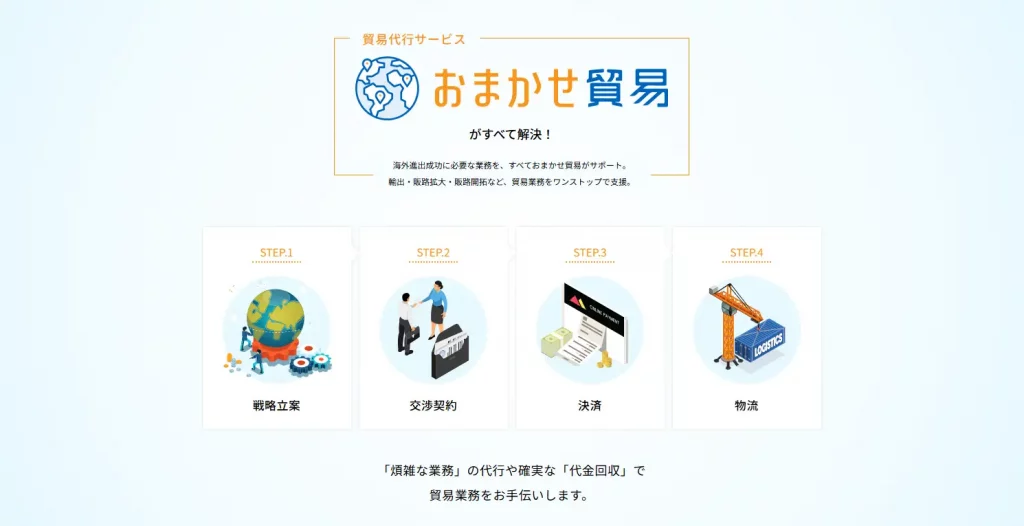
Omakase Trading will support you with all of these tasks necessary for expanding overseas.We cover all your trade business problems.
With the yen now at an unprecedented low, expanding into overseas markets is a great opportunity for all businesses.Omakase Trading removes such barriers to overseas expansion and accelerates our customers' business.We provide one-stop support for your overseas expansion, from overseas market research, to participating in exhibitions, acting as a sales agent, and developing sales channels.
For more details, please visit: https://boueki.standage.co.jp/digitrad/
Company Name: STANDAGE Co., Ltd.
・Established: March 7, 2017
Representative: Akira Adachi, President and CEO
• Address: Sumitomo Fudosan Landmark Plaza 3F, 1-6-7 Shibakoen, Minato-ku, Tokyo 105-0011, Japan
Business Description: Development and provision of a digital trade platform based on blockchain and AI technology.
・URL: https://standage.co.jp/
STANDAGE Co., Ltd. Marketing Department, Iizuka (TEL: 03-6435-3371 E-mail: info@standage.co.jp)
For trade-related inquiries, please contact us here.