Make global trade freer and simpler.
 English
  Japanese
Make global trade freer and simpler.
2025.3.18
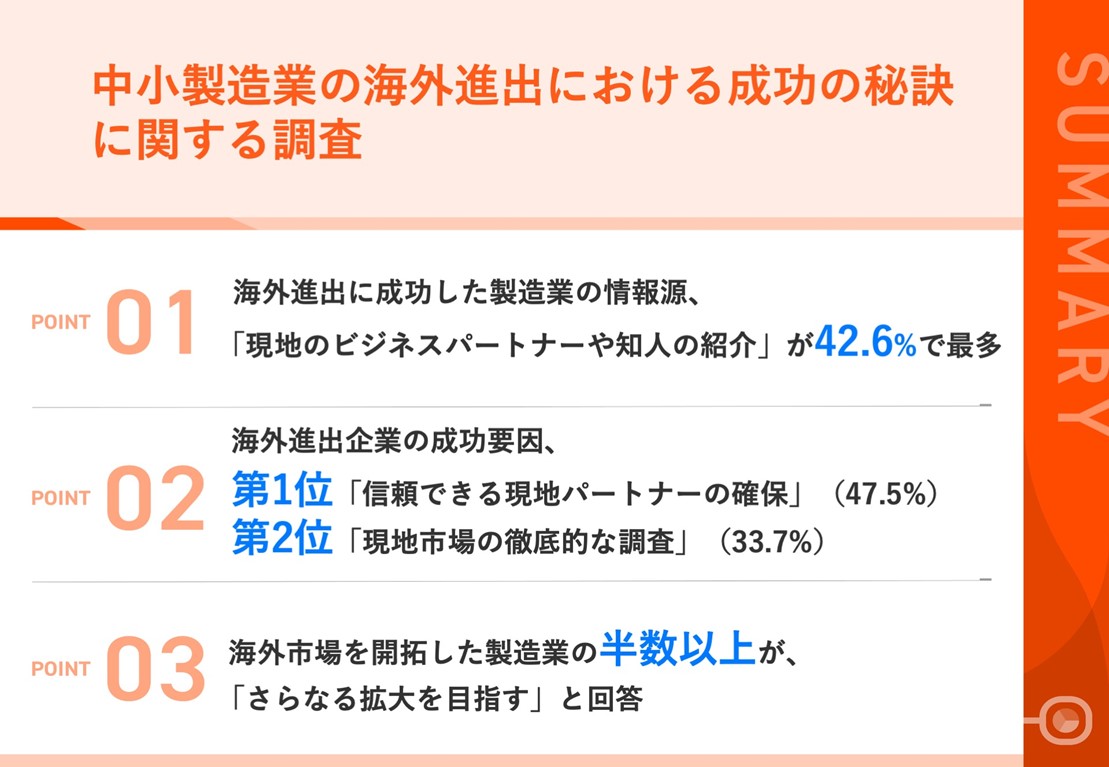
STANDAGE Co., Ltd. (Headquarters: Minato-ku, Tokyo; Representative Director & CEO: Akinori Adachi) has conducted a survey targeting 101 managers and executives of small and medium-sized manufacturing companies (with fewer than 1,000 employees) that have achieved a certain level of success in overseas expansion (increased overseas sales over the past three years) regarding the secrets to success in overseas expansion for small and medium-sized manufacturing companies.
Survey Overview
*1 | Some values have been rounded down to make the total 100%. Therefore, there may be slight differences from the actual calculated value.
| ≪Terms of use≫
1. Please clearly state "Omakase Trading" as the source of the information. 2 If you use this content on a website, please include the following link as the source. |
■ The main objectives of expanding overseas are "increasing sales and profits" and "developing new markets."
"Q1. What are the main reasons your company is expanding overseas? (Multiple answers allowed)"When asked (n=101),"Increasing sales and profits" was 57.41 TP3T, "Developing new markets" was 43.61 TP3T, and "Procurement of raw materials and parts" was 29.71 TP3T.The answer was:
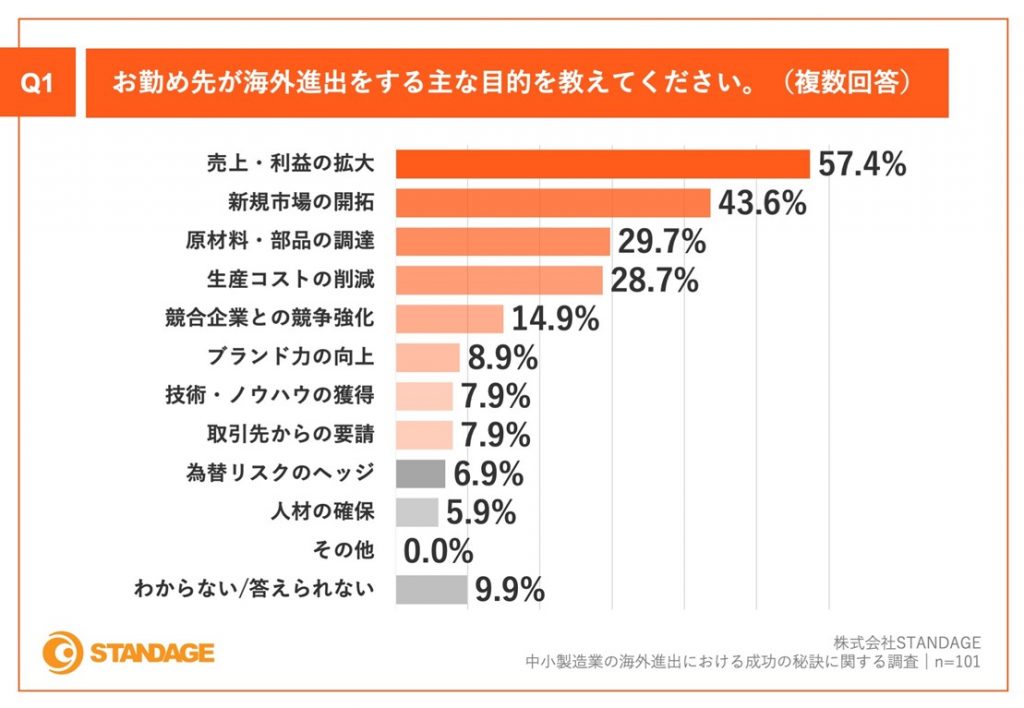
• Increased sales and profits: 57.4%
• Development of new markets: 43.6%
• Procurement of raw materials and parts: 29.7%
• Reduction in production costs: 28.7%
- Increased competition with rival companies: 14.9%
- Improved brand power: 8.9%
- Acquisition of technology and know-how: 7.9%
- Request from a business partner: 7.9%
- Exchange rate risk hedging: 6.9%
• Securing talent: 5.9%
・Other: 0.0%
・I don't know/cannot answer: 9.9%
■When considering overseas expansion, the most frequently cited source of information was "referrals from local business partners or acquaintances," at 42.6%.
"Q2. What information sources did you use when considering expanding overseas? (Multiple answers allowed)"When asked (n=101),"Introductions from local business partners or acquaintances" scored 42.61 TP3T, "Information from JETRO and government agencies" scored 31.71 TP3T, and "Industry associations and chambers of commerce" scored 26.71 TP3T.The answer was:
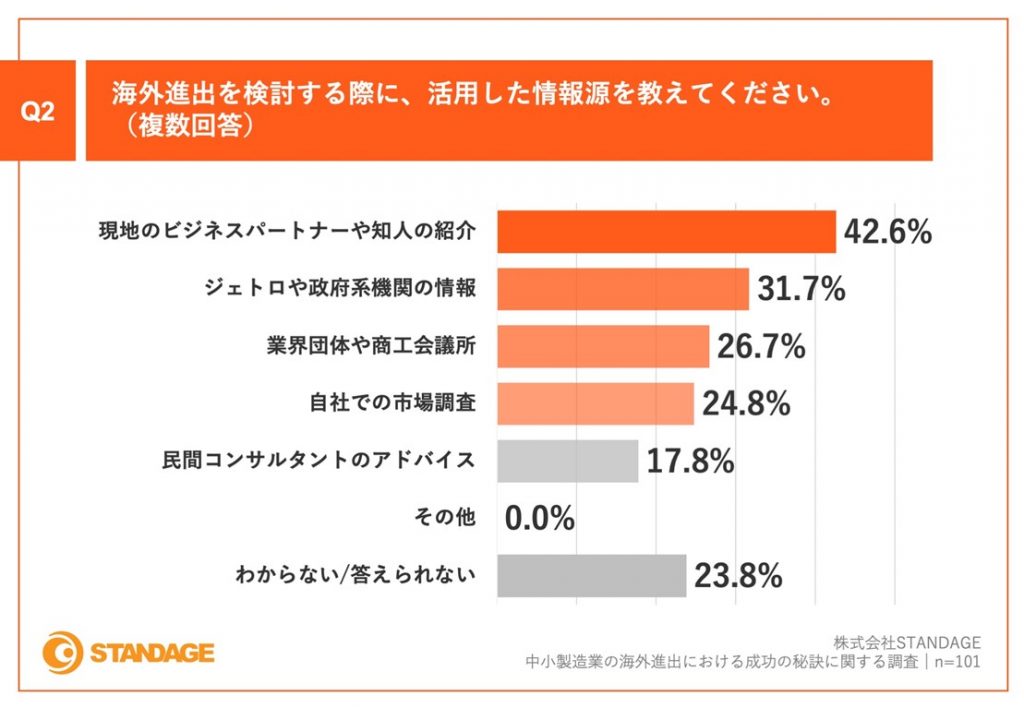
- Referral from local business partners or acquaintances: 42.6%
• Information from JETRO and other government agencies: 31.7%
• Industry associations and chambers of commerce: 26.7%
• In-house market research: 24.8%
• Advice from private consultants: 17.8%
・Other: 0.0%
・I don't know/cannot answer: 23.8%
■ Approximately half of respondents prioritize "securing a reliable local partner" in order to succeed in overseas expansion.
"Q3. What initiatives did you prioritize to ensure success in your overseas expansion? (Multiple answers allowed)"When asked (n=101),"Securing reliable local partners" scored 47.51 TP3T, "Thorough market research" scored 33.71 TP3T, and "Recruiting and developing high-quality personnel" scored 33.71 TP3T.The answer was: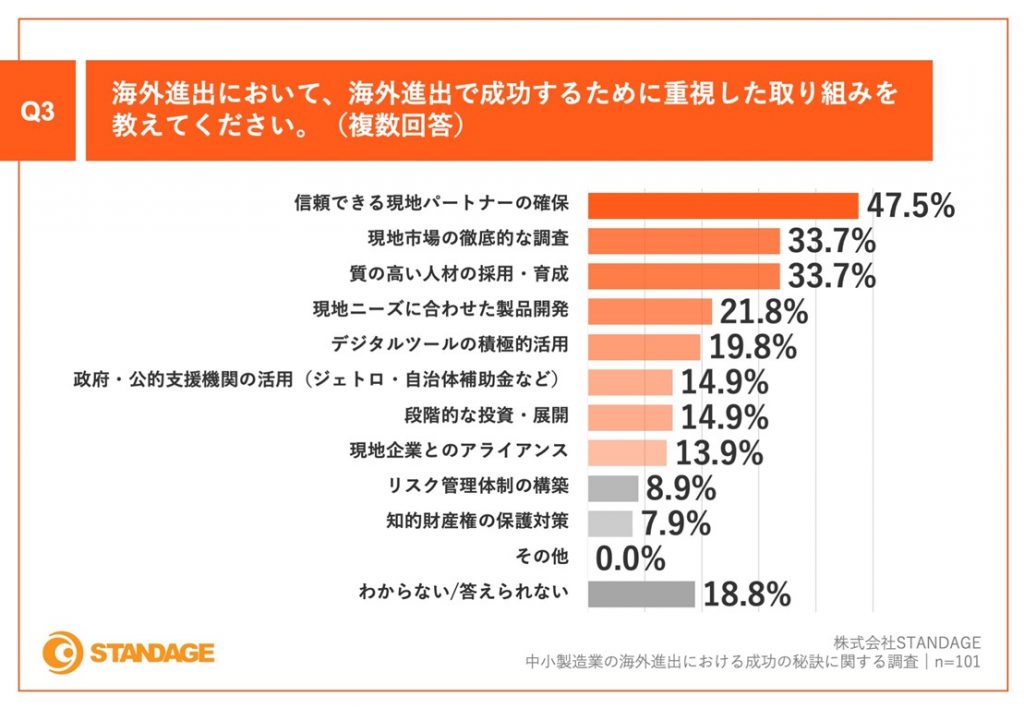
• Securing reliable local partners: 47.5%
• Thorough research of the local market: 33.7%
• Recruitment and development of high-quality personnel: 33.7%
• Product development tailored to local needs: 21.8%
• Active use of digital tools: 19.8%
・Utilization of government and public support organizations (JETRO, local government subsidies, etc.): 14.9%
• Phased investment and deployment: 14.9%
- Alliances with local companies: 13.9%
• Establishment of a risk management system: 8.9%
• Intellectual property rights protection measures: 7.9%
・Other: 0.0%
・I don't know/cannot answer: 18.8%
■When expanding overseas, the most common initial investment amount was "3 million to less than 5 million yen" at 16.8%.
"Q4. What was the initial investment amount (total amount of capital investment, personnel costs, marketing expenses, etc.) when you expanded overseas?"When asked (n=101),"3 million yen to less than 5 million yen" was 16.81 TP3T, "8 million yen to less than 10 million yen" was 10.91 TP3T, and "1 million yen to less than 3 million yen" was 10.91 TP3T.The answer was:
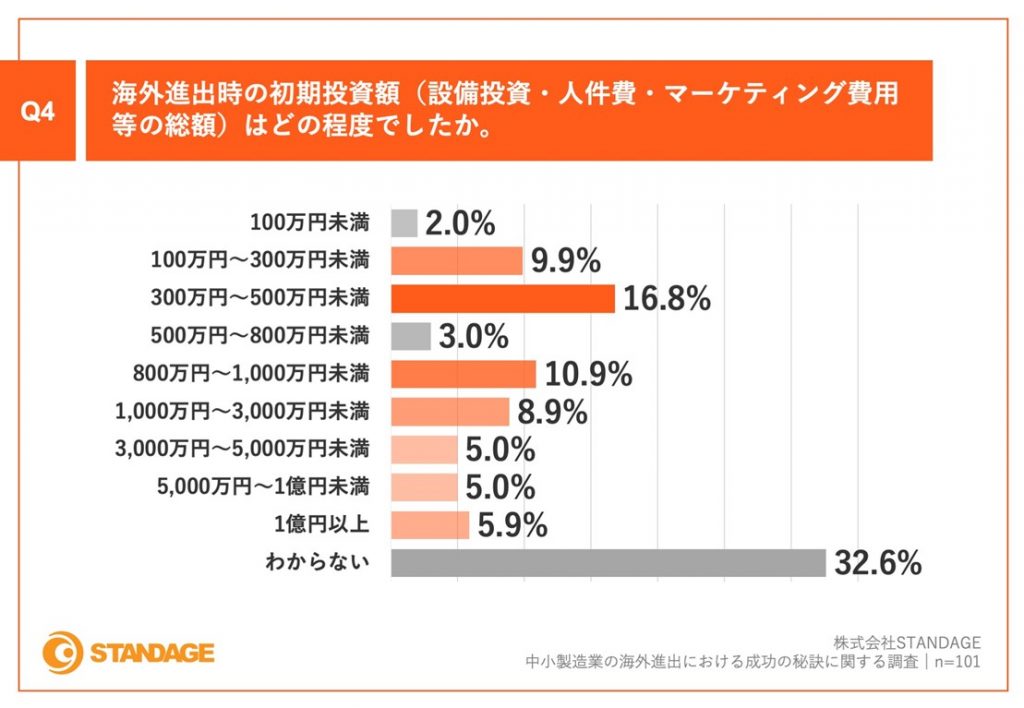
- Less than 1 million yen: 2.0%
・1 million yen to less than 3 million yen: 9.9%
・3 million yen to less than 5 million yen: 16.8%
・5 million yen to less than 8 million yen: 3.0%
・8 million yen to less than 10 million yen: 10.9%
・¥10 million to less than ¥30 million: 8.9%
・30 million yen to less than 50 million yen: 5.0%
・50 million yen to less than 100 million yen: 5.0%
・Over 100 million yen: 5.9%
・Unknown: 32.6%
■The most effective methods for developing sales channels included "utilizing local agents" and "collaborating with local companies."
"Q5. What was the most effective method you used to develop sales channels locally?"When asked (n=101),"Utilizing local agents" scored 22.71 TP3T, "Collaborating with local companies" scored 21.81 TP3T, and "Exhibiting at trade shows and exhibitions" scored 20.81 TP3T.The answer was: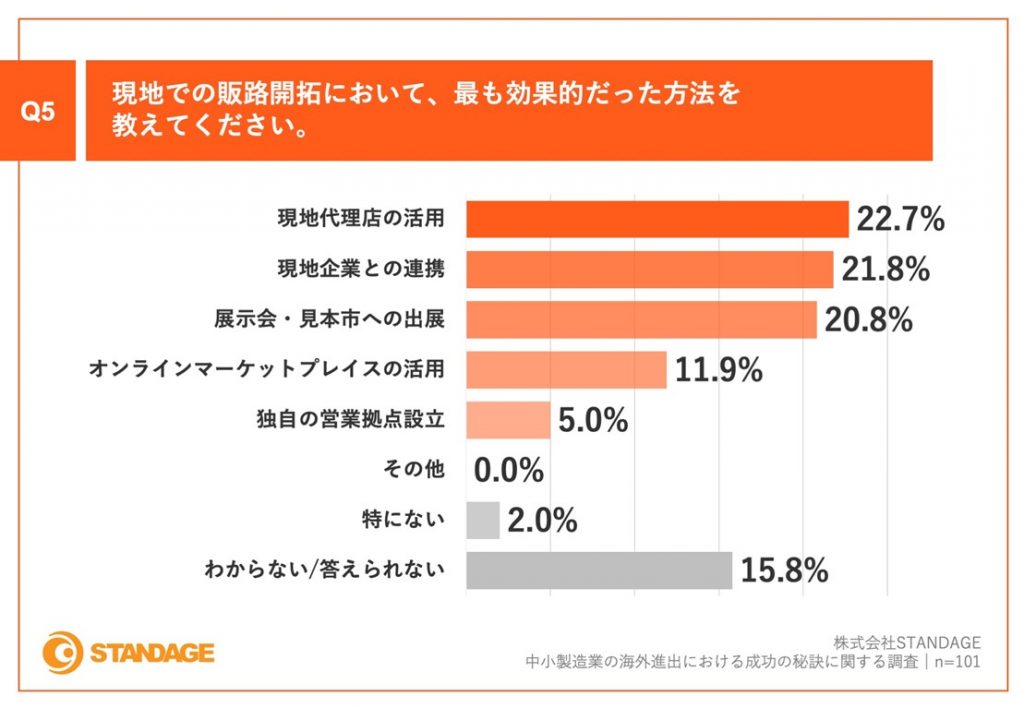
・Utilization of local agents: 22.7%
• Collaboration with local companies: 21.8%
- Participation in exhibitions and trade fairs: 20.8%
・Utilizing online marketplaces: 11.9%
- Establishment of independent sales offices: 5.0%
・Other: 0.0%
- Nothing in particular: 2.0%
・I don't know/cannot answer: 15.8%
■ More than 40% utilize "online marketplaces (Amazon, Alibaba, etc.)" for expanding sales channels and branding in overseas markets.
"Q6. How are you currently utilizing online strategies (digital tools) for expanding sales channels and branding in overseas markets? (Multiple answers allowed)"When asked (n=101),"Utilizing online marketplaces (Amazon, Alibaba, etc.)" received 40.61 TP3T, "Operating our own e-commerce site (for overseas markets)" received 29.71 TP3T, and "Conducting promotions on social media (Facebook, Instagram, LinkedIn, etc.)" received 27.71 TP3T.The answer was: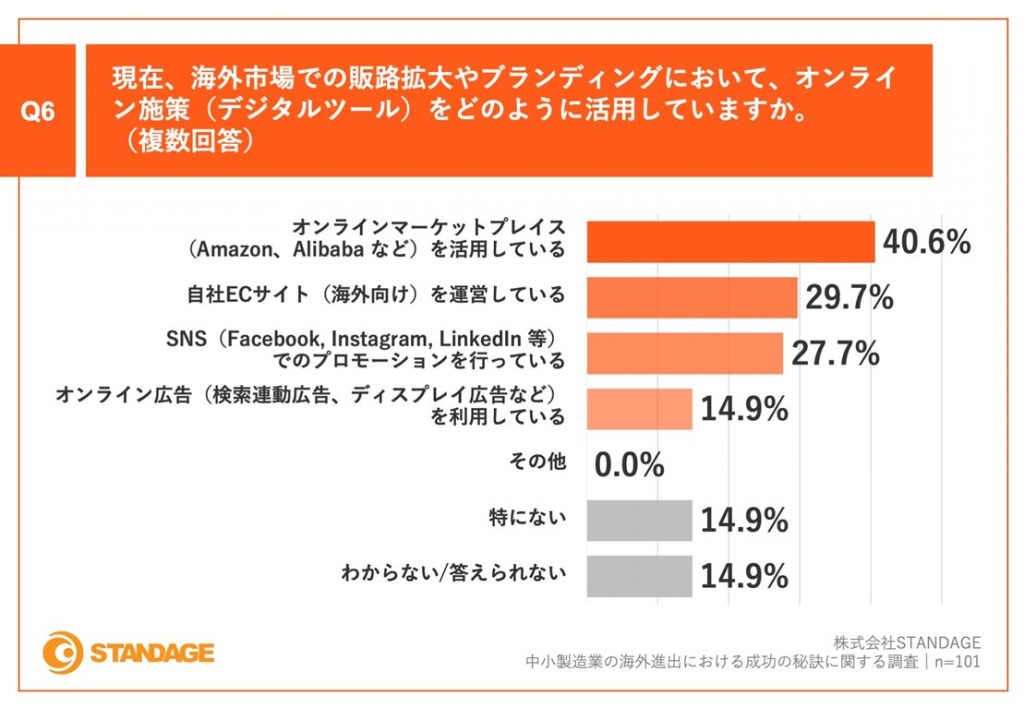
• Utilizing online marketplaces (Amazon, Alibaba, etc.): 40.6%
• Operates its own e-commerce site (for overseas customers): 29.7%
• We are conducting promotions on social media (Facebook, Instagram, LinkedIn, etc.): 27.7%
• Uses online advertising (search ads, display ads, etc.): 14.9%
・Other: 0.0%
- Nothing in particular: 14.9%
・I don't know/cannot answer: 14.9%
■44.6% of respondents focus on "market growth potential" when selecting overseas expansion destinations.
"Q7. What criteria did you prioritize when selecting overseas expansion destinations? (Multiple answers allowed)"When asked (n=101),"Market growth potential" scored 44.61 TP3T, "Competitive landscape" scored 38.61 TP3T, and "Regulations and permits" scored 33.71 TP3T.The answer was:
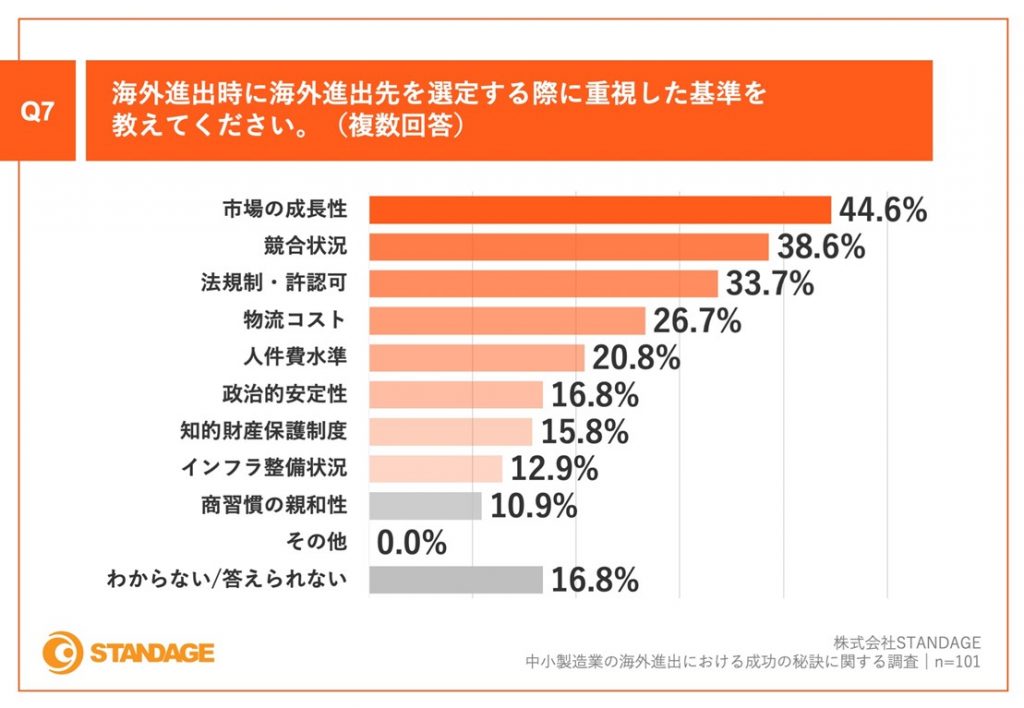
Market growth potential: 44.6%
• Competitive situation: 38.6%
・Legal regulations/permits: 33.7%
Logistics costs: 26.7%
• Labor cost level: 20.8%
・Political stability: 16.8%
• Intellectual property protection system: 15.8%
Infrastructure development status: 12.9%
• Compatibility with business practices: 10.9%
・Other: 0.0%
・I don't know/cannot answer: 16.8%
■The biggest challenge in deciding to expand overseas was: 1st place: "Selecting partner companies (local agents, joint venture partners, etc.)", 2nd place: "Determining the scale and schedule of investment".
"Q8. Please describe the challenges you faced in deciding to expand overseas. (Multiple answers allowed)"When asked (n=101),"Selection of partner companies (local agents, joint venture partners, etc.)" was 37.61 TP3T, "Determination of investment scale and schedule" was 34.71 TP3T, and "Determination of business areas and business models to be developed" was 33.71 TP3T.The answer was: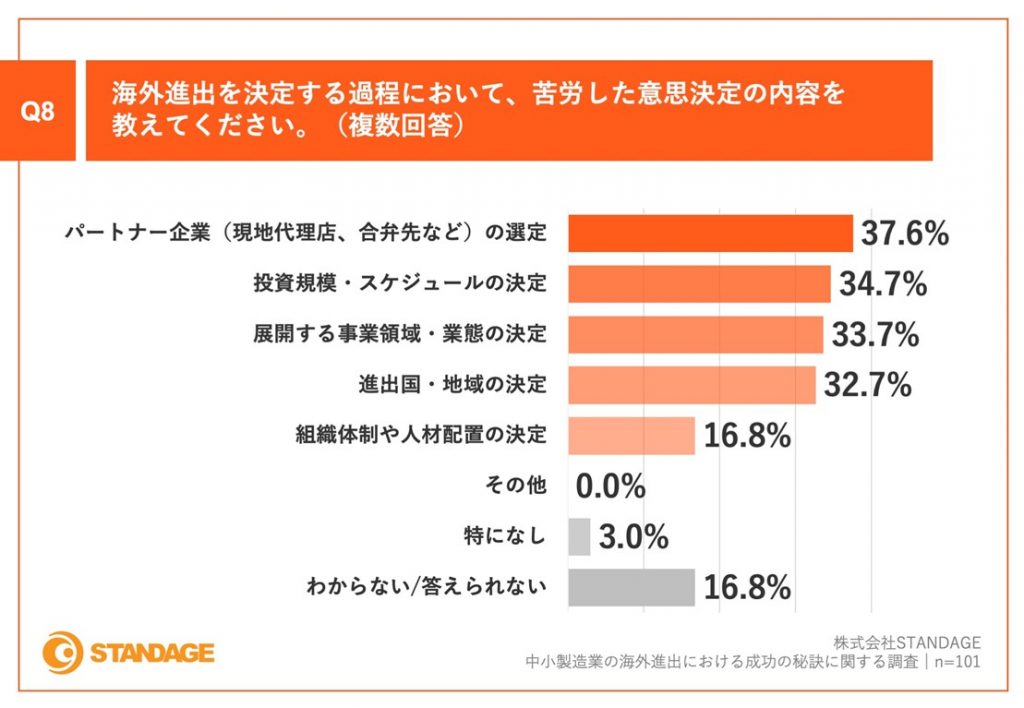
- Selection of partner companies (local agents, joint venture partners, etc.): 37.6%
- Determination of investment scale and schedule: 34.7%
- Determining the business areas and business models to develop: 33.7%
- Decision on the country/region to enter: 32.7%
- Determining organizational structure and personnel allocation: 16.8%
・Other: 0.0%
- None in particular: 3.0%
・I don't know/cannot answer: 16.8%
■Regarding future overseas expansion, more than half aim for further expansion.
"Q9. What are your plans for future overseas expansion?"When asked (n=101),"Aiming for further expansion" received 50.51 TP3T, while "Aiming to maintain the status quo" received 22.81 TP3T.The answer was: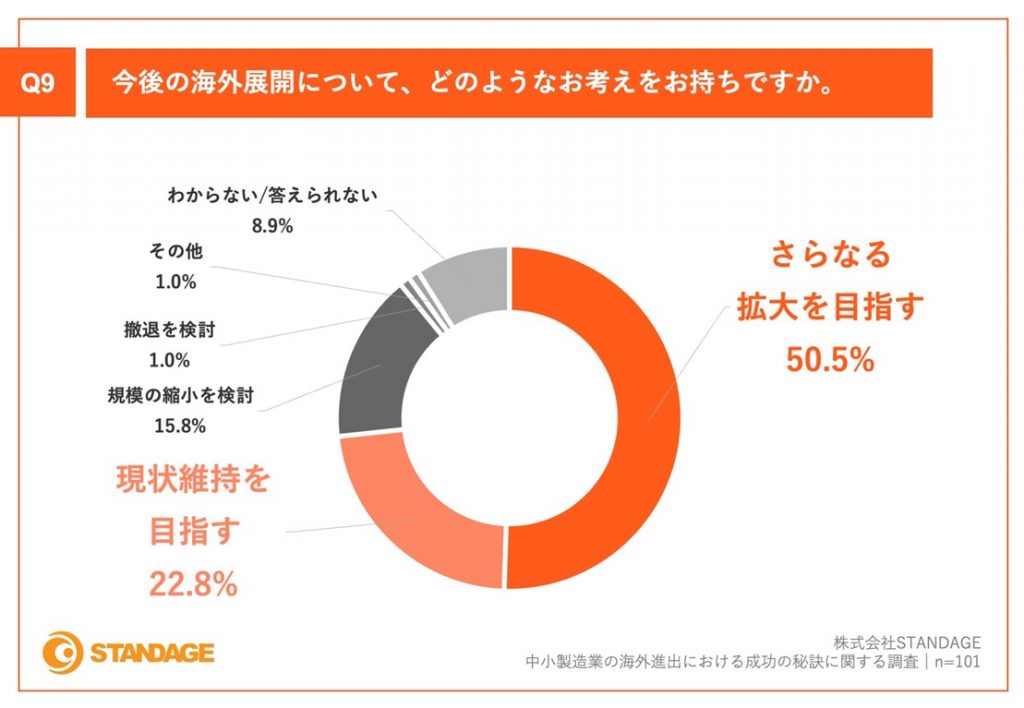
• Aiming for further expansion: 50.5%
- Aim to maintain the status quo: 22.8%
- Considering scaling down: 15.8%
- Considering withdrawal: 1.0%
Other: 1.0%
・I don't know/cannot answer: 8.9%
■ More than half will focus on "entering new markets" in their future overseas expansion.
"Q10. What initiatives would you like to focus on in your future overseas expansion? (Multiple answers allowed)"When asked (n=101),"Entering new markets" scored 45.51 TP3T, "Increasing market share in existing markets" scored 37.61 TP3T, and "Expanding product lineup" scored 35.61 TP3T.The answer was: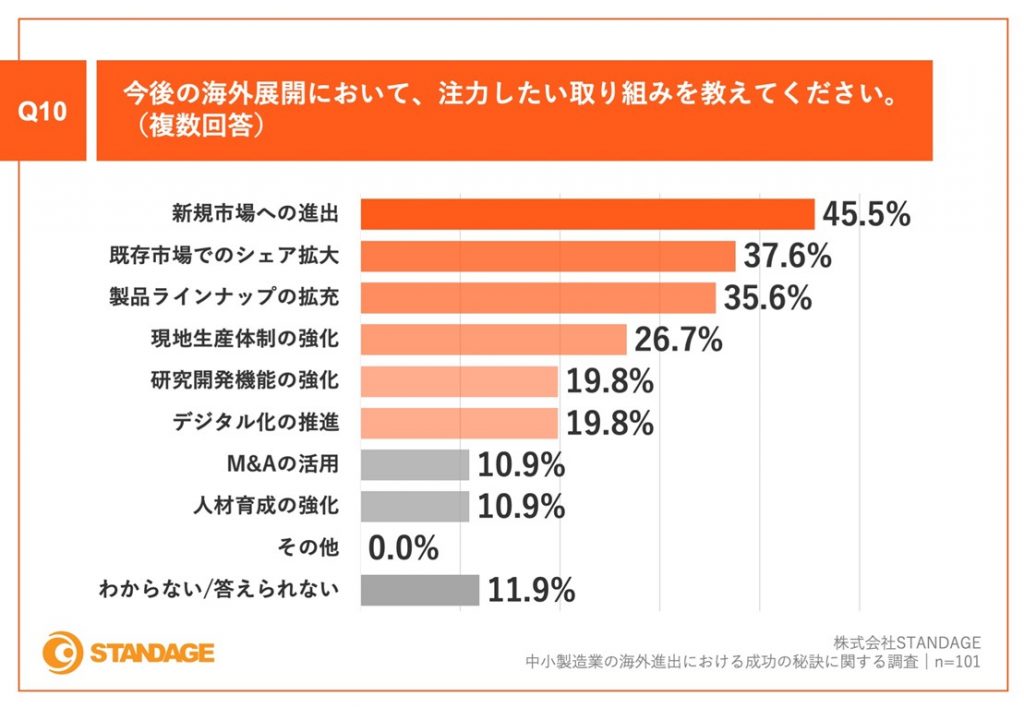
- Entry into new markets: 45.5%
- Increased market share in existing markets: 37.61 TP3T
- Expansion of product lineup: 35.6%
- Strengthening of local production system: 26.7%
- Strengthening research and development capabilities: 19.8%
• Promotion of digitalization: 19.8%
• Utilization of M&A: 10.9%
- Strengthening human resource development: 10.9%
・Other: 0.0%
・I don't know/cannot answer: 11.9%
■ Summary
This time, we conducted a survey targeting 101 managers and executives of small and medium-sized manufacturing companies (with fewer than 1,000 employees) that have expanded overseas and achieved a certain level of success (increased overseas sales over the past three years), to find out the secrets to success in overseas expansion for small and medium-sized manufacturing companies.
For small and medium-sized manufacturers, overseas expansion is driven not merely by survival instincts, but by a growth-oriented mindset. The survey revealed that 57.41 TP3T cited "expanding sales and profits" as their objective, and more than half indicated their intention to further expand their overseas business. This clearly demonstrates their emphasis on overseas markets as a future source of revenue.
Securing local partners is considered crucial for success. When entering the market, 42.6% relied on "introductions from local business partners and acquaintances," while 47.5% cited "securing trustworthy local partners" as a key success factor. Developing networks and partnership strategies in advance is a shortcut to success.
Another characteristic is a prudent investment stance that minimizes risk (*2). The most common initial investment amount is "3 million to less than 5 million yen," and when selecting a market to enter, "market growth potential" (44.6%) is the most important factor, with securing sales channels through "utilizing local agents" (22.7%) being considered effective. Companies are adopting strategies that seek growth by looking at untapped markets.
Against this backdrop, the trend is to focus on "entering new markets" (45.5%) while also concentrating on "expanding market share in existing markets" (37.6%) and "expanding product lineups" (35.6%). In particular, there is a noticeable effort to actively explore new growth opportunities while simultaneously working to expand the size of existing markets and diversify products.
The challenges include "understanding the local market" and "organizational response." While 33.7% cites "thorough research of the local market" as a success factor, the difficulty in selecting partners is also a challenge. To overcome these, thorough market research and a long-term perspective from the entire organization are required.
In general, companies are pursuing comprehensive growth strategies that diversify risk by targeting untapped new markets while simultaneously expanding their market share and strengthening their product lineups in existing markets. These efforts are expected to lead to enhanced competitiveness and sustainable growth in overseas markets.
This survey revealed the importance of securing reliable local partners and conducting market research for small and medium-sized manufacturing companies expanding overseas. With the domestic market shrinking, more companies are making overseas expansion a cornerstone of their growth strategy, and the weak yen is also providing a tailwind (*3). On the other hand, there are many challenges when expanding overseas, such as determining the scale of investment and selecting appropriate partners. The government is also strengthening its efforts to support the overseas expansion of SMEs, and support measures for market development and fundraising are being expanded (*4). Given this environment, companies are required to streamline trade operations and strengthen risk management, and there is a need for means to realize smoother overseas expansion.
*2 | Hitotsubashi University HQ Web Magazinehttps://x.gd/QR4BI
*3 | Small and Medium Enterprise Agencyhttps://x.gd/1CeDw
*4 | Nikkei |https://www.nikkei.com/article/DGXZQOCC04CCU0U4A001C2000000/
JETRO |https://www.jetro.go.jp/biz/areareports/special/2022/1002/a9c529af460e7ded.html
*5 | Prime Minister's Office |https://www.kantei.go.jp/jp/101_kishida/statement/2023/1023shoshinhyomei.html
■Handle all your trade needs with us | Trade agency service "Omakase Trade"
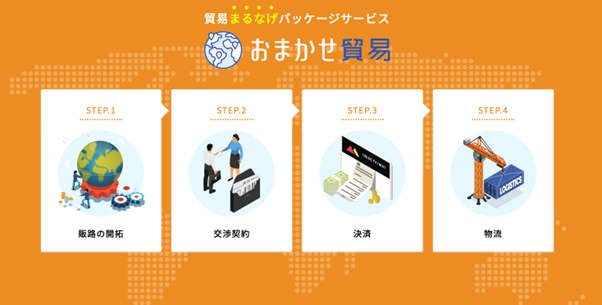
STANDAGE will support you with all the tasks necessary for successful overseas expansion.
We provide one-stop support for trade operations, including exporting, expanding sales channels, and developing sales channels.
Due to the recent sustained depreciation of the yen and the government's efforts to expand exports, Japan's overall export volume has been on a gradual upward trend. However, when looking at the export volume of small and medium-sized enterprises in urban and rural areas, the gap is still widening.
To enable small and medium-sized manufacturers throughout Japan to expand overseas more freely and easily, we offer a package service that handles everything from market development and contracts/negotiations to settlements and logistics, providing a complete "leave it to us" trade creation service. As of August 2024, the total number of companies that have adopted our service has reached 250.
For more information:https://standage.co.jp/service/omakase/
■Company Profile
Company name: STANDAGE Co., Ltd.
Established: March 7, 2017
Representative: Akira Adachi, President and CEO
Address: Sumitomo Fudosan Landmark Plaza 3F, 1-6-7 Shibakoen, Minato-ku, Tokyo 105-0011, Japan
Business Description: Development and provision of a digital trade platform based on blockchain and AI technologies.
For trade-related inquiries, please contact us here.