Make global trade freer and simpler.
 English
  Japanese
Make global trade freer and simpler.
2026.1.23
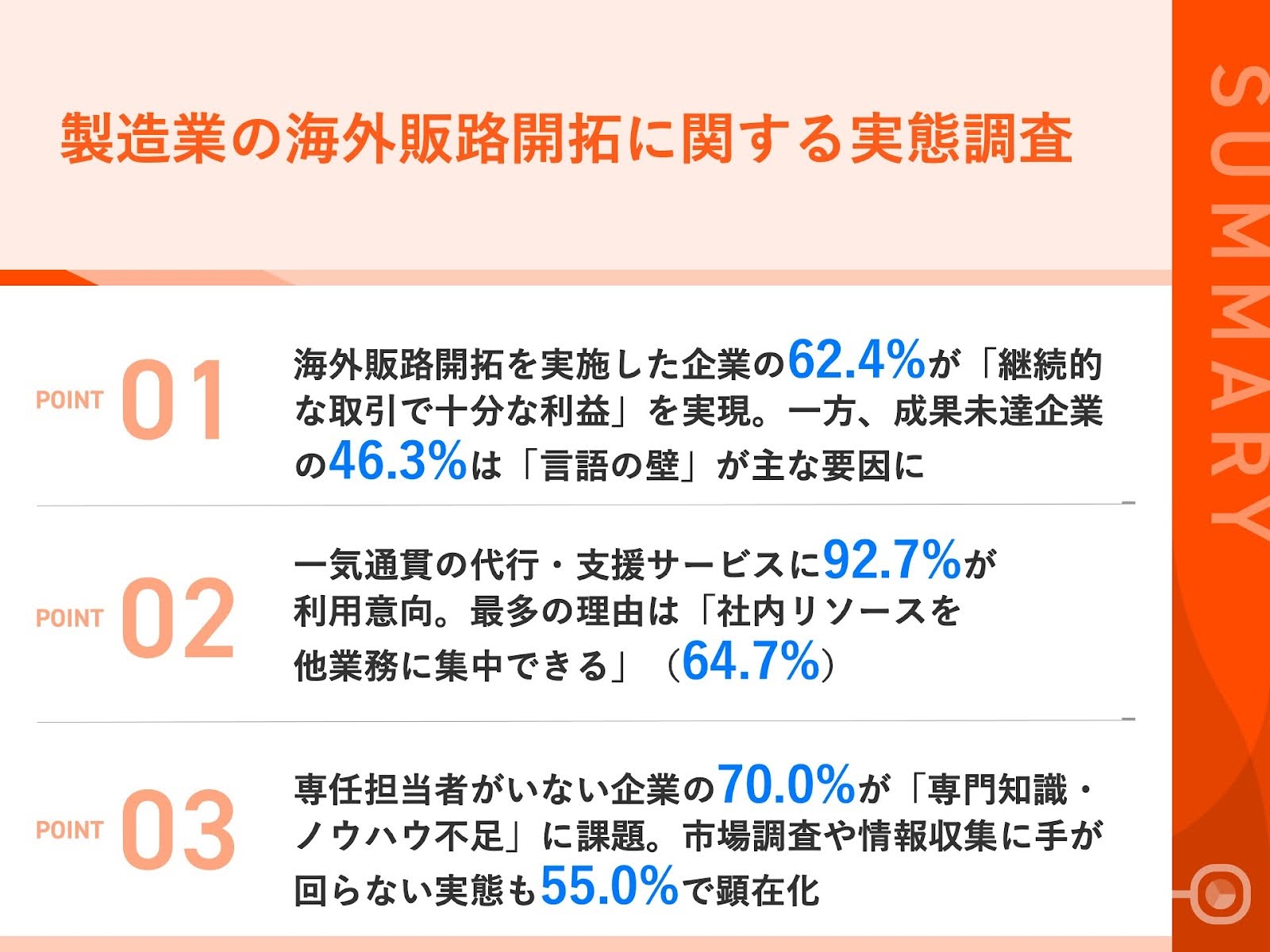
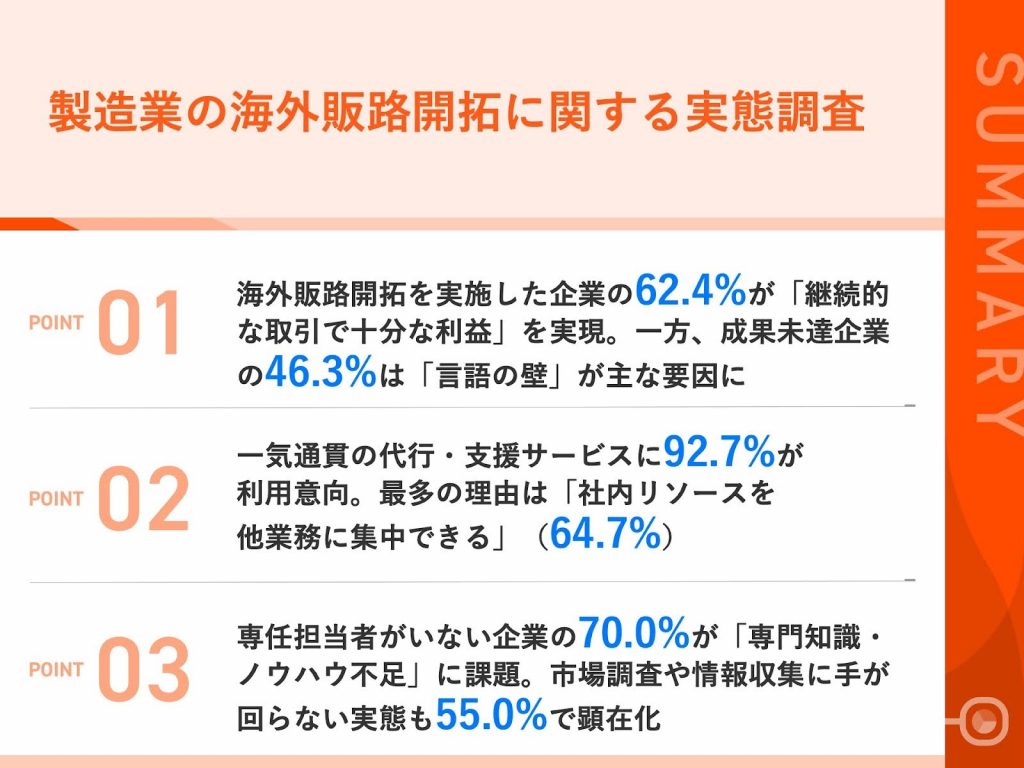
STANDAGE Co., Ltd. (Minato-ku, Tokyo; President and CEO: Akinori Adachi; hereinafter referred to as STANDAGE), a company that develops and provides digital trade platforms, conducted a survey on the current state of overseas market development in the manufacturing industry, targeting 110 people working in the manufacturing industry who are involved in or have experience in overseas market development. The results are as follows:
Download this surveyHerefrom.
*The composition ratios are rounded to the first decimal place, so the total may not necessarily add up to 100.
| ≪Terms of use≫
1. Please clearly state "Omakase Trading" as the source of the information. 2 If you use this content on a website, please include the following link as the source. URL:https://boueki.standage.co.jp/digitrad/https://standage.co.jp/omakase |
"Q1. Please tell us about the overseas market development measures your company has implemented within the past three years. (Multiple answers allowed)"When asked (n=110),"Exhibiting at international trade shows held domestically" was 59.11 TP3T, "Participating in JETRO (Japan External Trade Organization) support and business matching events" was 52.71 TP3T, and "Exhibiting at overseas trade shows" was 50.91 TP3T.The answer was:
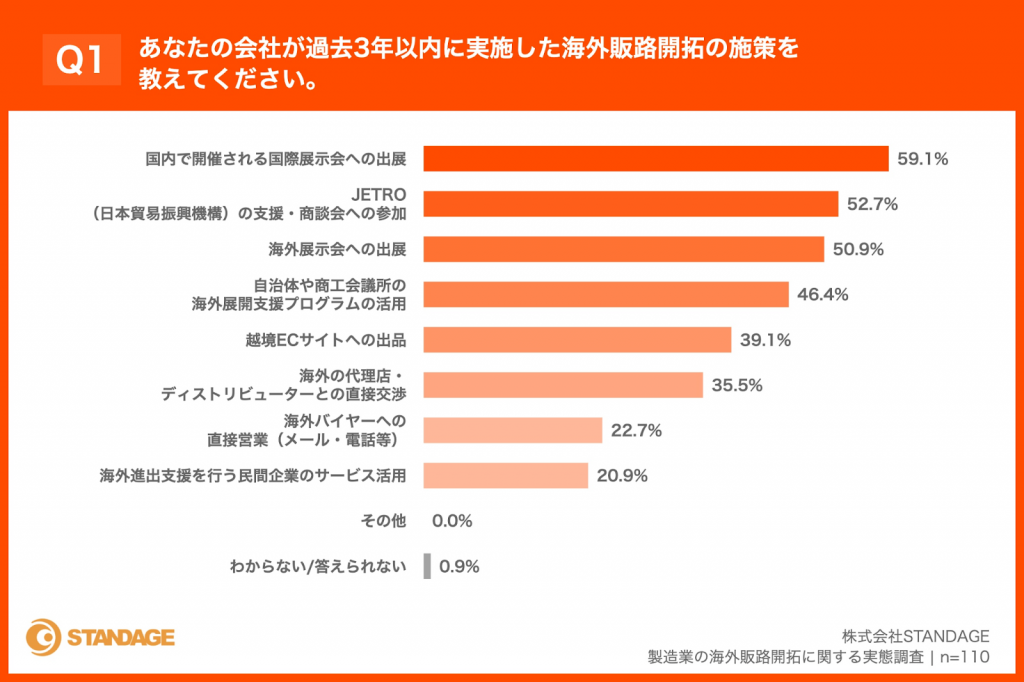
・Participation in international exhibitions held domestically: 59.1%
・Participation in JETRO (Japan External Trade Organization) support and business matching events: 52.7%
・Exhibiting at overseas trade shows: 50.9%
・Utilizing overseas expansion support programs offered by local governments and chambers of commerce: 46.4%
- Listing on cross-border e-commerce sites: 39.1%
- Direct negotiation with overseas agents/distributors: 35.5%
• Direct sales to overseas buyers (email, phone, etc.): 22.7%
・Utilization of services from private companies that support overseas expansion: 20.9%
・Other: 0.0%
・I don't know/cannot answer: 0.9%
"Q2. For those who answered something other than "I don't know/cannot answer" in Q1, have the measures you mentioned in Q1 led to 'continued business transactions' with overseas partners?"When asked (n=109),"Leading to continuous trading and generating sufficient profits" received 62.41 TP3T, while "Leading to continuous trading, but profits are not as high as expected" received 28.41 TP3T.The answer was:
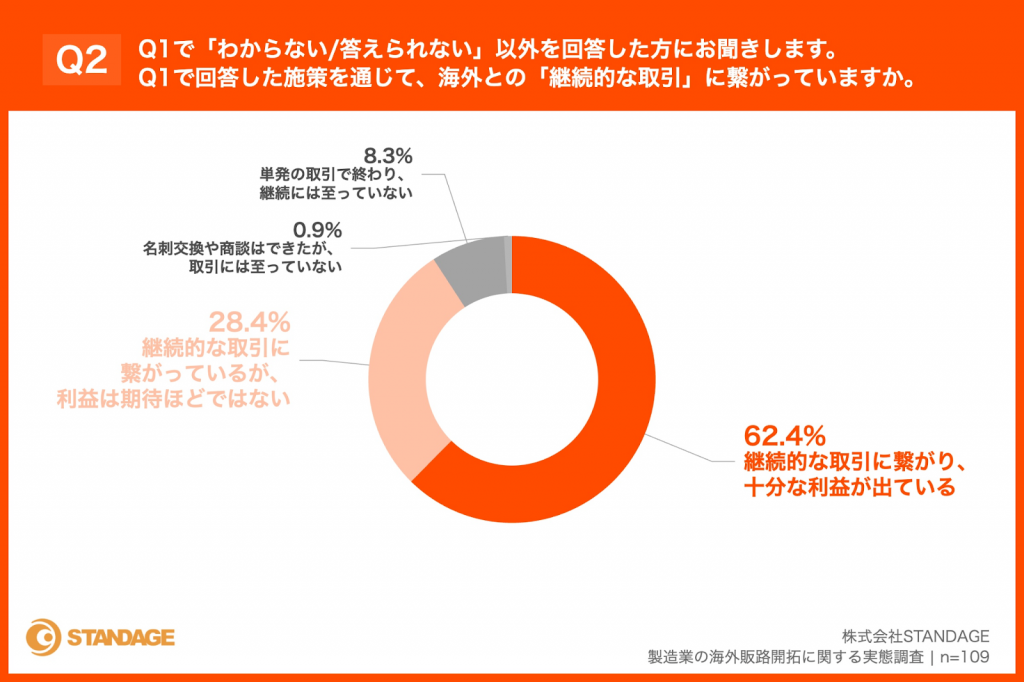
・This has led to continued trading and generated substantial profits: 62.4%
・While it has led to continued trading, profits are not as high as expected: 28.4%
- This was a one-off transaction and did not lead to continuation: 8.3%
- Business cards were exchanged and discussions took place, but no transaction occurred: 0.9%
- Withdrew or discontinued before results were achieved: 0.0%
"Q3. For those who answered anything other than 'Leaded to continuous transactions and generated sufficient profits' in Q2, please tell us which of the following factors apply to why your overseas sales channel development did not yield the expected results. (Multiple answers allowed)"When asked (n=41),"Language barriers hindered negotiations and contracts" received 46.31 TP3T, "Communication with local buyers was lost" received 43.91 TP3T, and "Dealing with local regulations and certifications took too much time and cost" received 43.91 TP3T.The answer was:
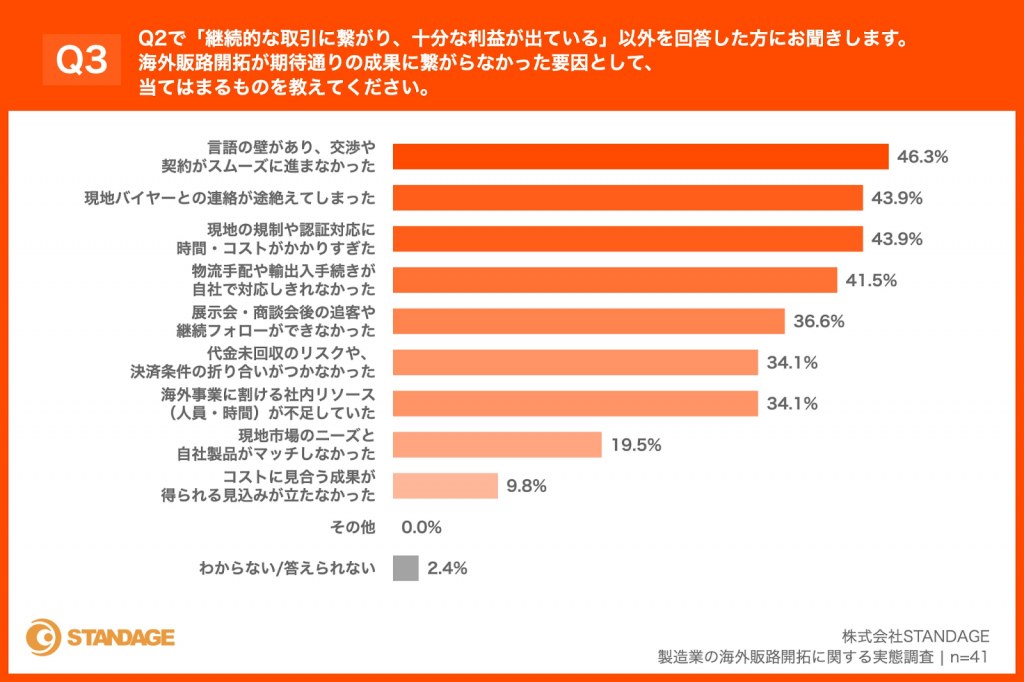
・Language barriers hindered negotiations and contracts: 46.3%
・Communication with the local buyer has been lost: 43.9%
・The local regulations and certification process took too much time and cost: 43.9%
- We were unable to handle logistics arrangements and import/export procedures in-house: 41.5%
- Inability to follow up with customers or provide ongoing support after trade shows and business meetings: 36.6%
- Risk of non-payment or inability to agree on payment terms: 34.1%
- Insufficient internal resources (personnel and time) available for overseas business: 34.1%
- Our products did not match the needs of the local market: 19.5%
- The expected results did not justify the cost: 9.8%
・Other: 0.0%
・I don't know/cannot answer: 2.4%
"Q4. For those who answered something other than "I don't know/cannot answer" in Q3, please tell us if there were any other factors besides those you mentioned in your answer to Q3 that prevented your overseas sales channel development from achieving the expected results."When asked (n=40),There were 12 main responses.I was able to get the answer.
<Free answers, excerpts>
• Cost issues
- Misunderstandings due to language and culture
Things are different domestically and internationally, so it's difficult.
"Q5. Does your company have an employee who is solely responsible for developing overseas sales channels?"When asked (n=110),"Having a dedicated person in charge" received 45.51 TP3T, while "Handling it in addition to other duties (handling overseas business alongside their main job)" received 36.41 TP3T.The answer was:
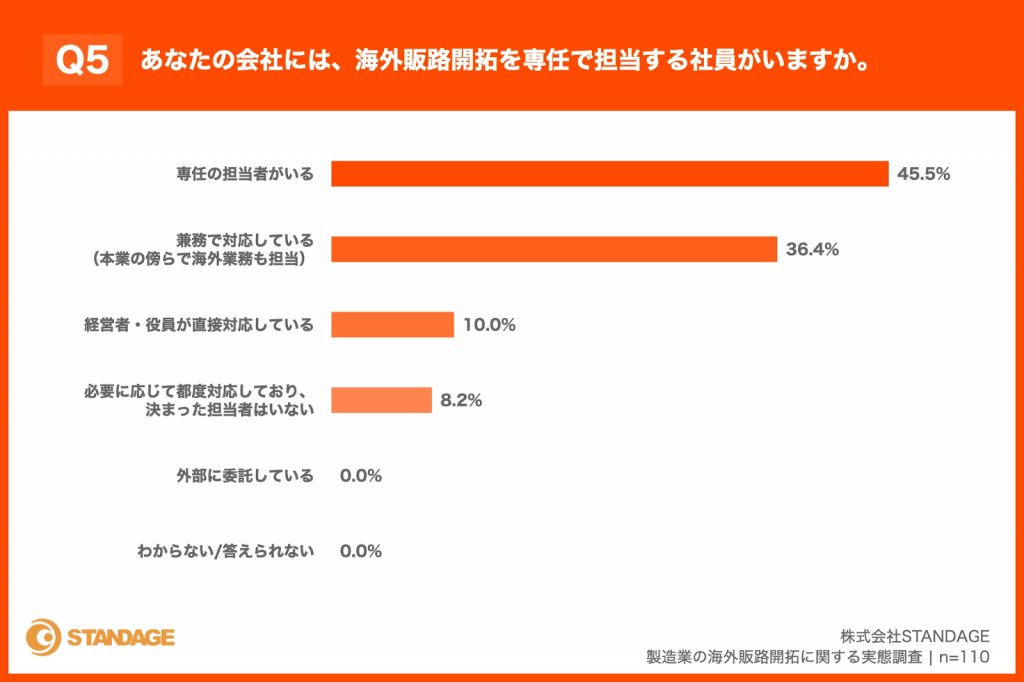
・Dedicated staff available: 45.5%
・Handling this in addition to my main job (handling overseas business alongside my main job): 36.4%
• Directly handled by management/executives: 10.0%
- We handle things on a case-by-case basis as needed, and there is no designated person in charge: 8.2%
- Outsourced: 0.0%
・Don't know/can't answer: 0.0%
"Q6. For those who answered anything other than 'We have a dedicated person in charge' or 'We outsource it' in Q5, please tell us what difficulties you are facing in developing overseas sales channels due to a lack of internal resources. (Multiple answers allowed)"(n=20)"Lack of in-house expertise and know-how necessary for overseas transactions" was cited by 70.01 TP3T, "Insufficient resources for market research and gathering local information" by 55.01 TP3T, and "Lack of personnel capable of handling practical tasks such as logistics, customs clearance, and settlement" by 45.01 TP3T.The answer was:
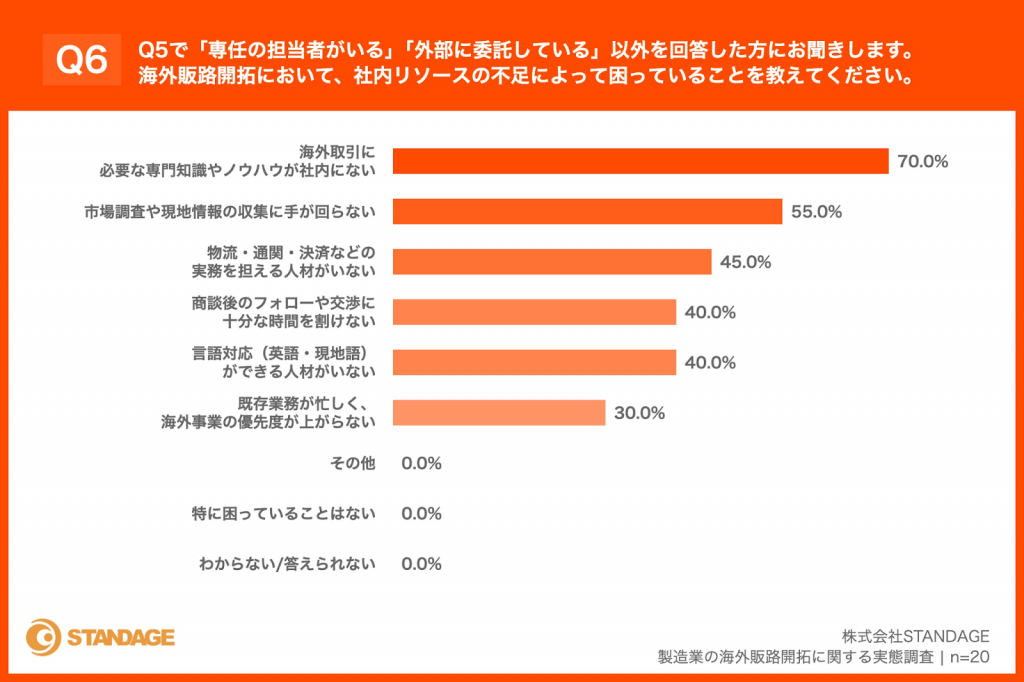
・The company lacks the necessary expertise and know-how for overseas transactions: 70.0%
・We don't have time for market research or gathering local information: 55.0%
・Lack of personnel capable of handling logistics, customs clearance, and payment processing: 45.0%
- Insufficient time for follow-up and negotiation after business negotiations: 40.0%
- Lack of personnel capable of handling language support (English and local language): 40.0%
- Existing tasks are too demanding, and overseas business cannot be given a higher priority: 30.0%
・Other: 0.0%
- I don't have any particular problems: 0.0%
・Don't know/can't answer: 0.0%
"Q7. If there was a service that could handle and support everything from strategy planning to local negotiations, logistics, and payment in developing overseas sales channels, would you be interested in using it?"When asked (n=110),"Would very much like to use it" received 50.01 TP3T, while "Would somewhat like to use it" received 42.71 TP3T.The answer was:
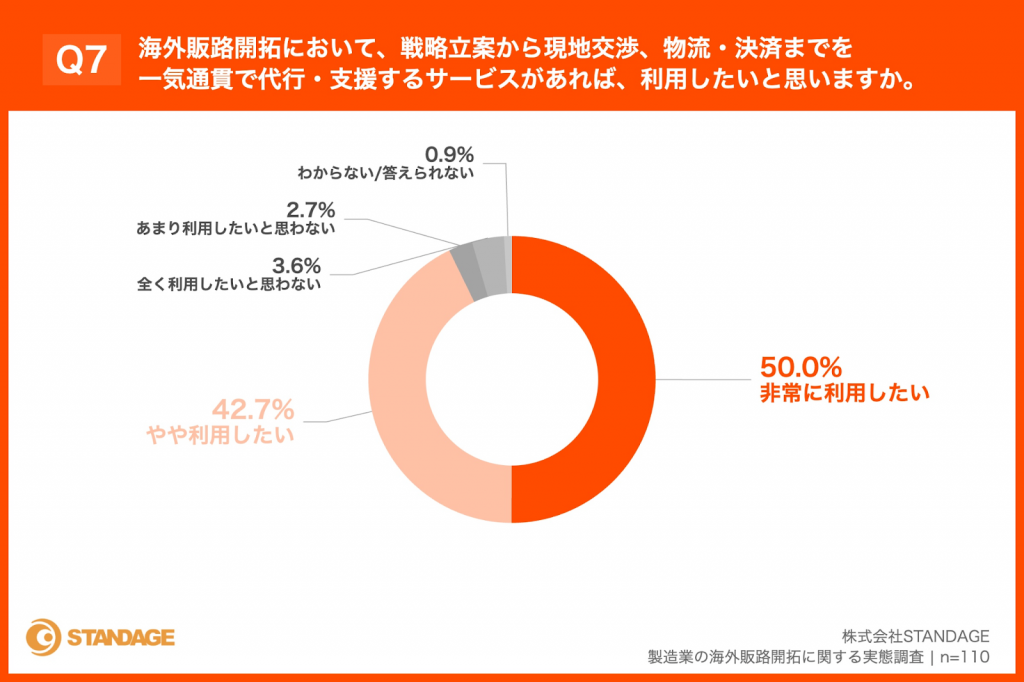
・I would very much like to use this: 50.0%
・I'd like to use it somewhat: 42.7%
I don't really want to use it: 2.7%
I have absolutely no desire to use it: 3.6%
・I don't know/cannot answer: 0.9%
"Q8. For those who answered "I would very much like to use it" or "I would somewhat like to use it" in Q7, please tell us your reasons for wanting to use a comprehensive outsourcing and support service. (Multiple answers allowed)"When asked (n=102),"Because it allows us to concentrate internal resources on other tasks" received 64.71 TP3T, "Because we believe it will reduce the risk of failure" received 47.11 TP3T, and "Because we can proceed with overseas transactions even without specialized knowledge" received 43.11 TP3T.The answer was:
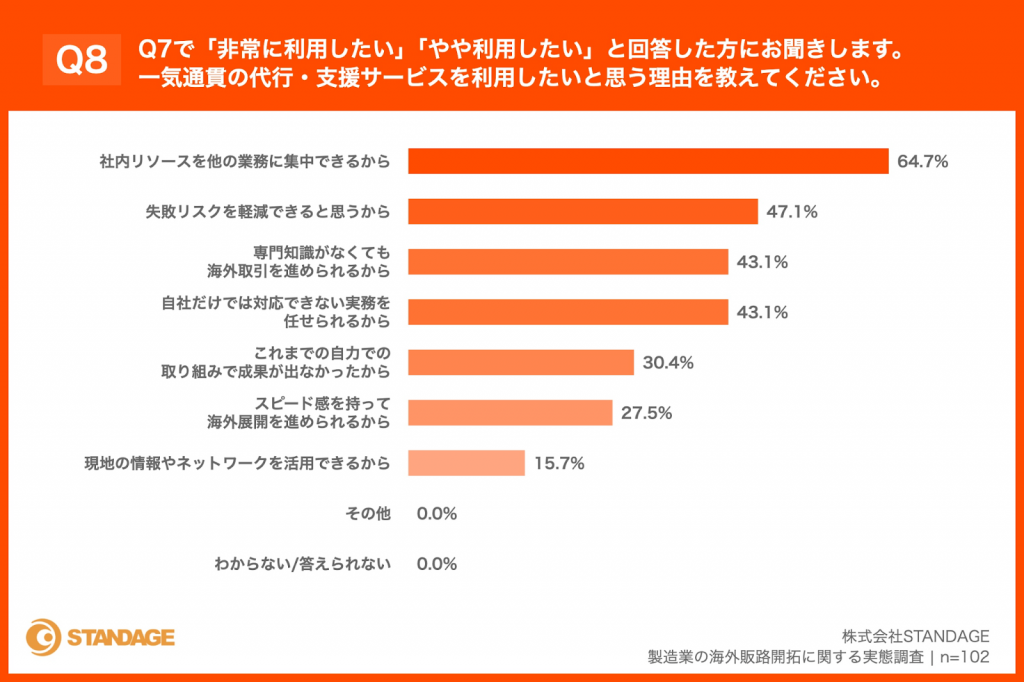
・Because it allows us to concentrate internal resources on other tasks: 64.7%
・Because I think it will reduce the risk of failure: 47.1%
・Because you can conduct overseas transactions even without specialized knowledge: 43.1%
- Because we can entrust them with practical tasks that we cannot handle ourselves: 43.1%
- Because previous efforts on my own have not yielded results: 30.4%
- Because it allows for rapid overseas expansion: 27.5%
- Because we can utilize local information and networks: 15.7%
・Other: 0.0%
・Don't know/can't answer: 0.0%
"Q9. For those who answered "I don't really want to use it" or "I don't want to use it at all" in Q7, please tell us why you don't want to use a comprehensive outsourcing/support service. (Multiple answers allowed)"When asked (n=7),"Because we want to accumulate know-how in-house" was cited by 57.11 TP3T, "Because the cost-effectiveness is unclear" by 42.91 TP3T, and "Because we have concerns about outsourcing" by 42.91 TP3T.The answer was:
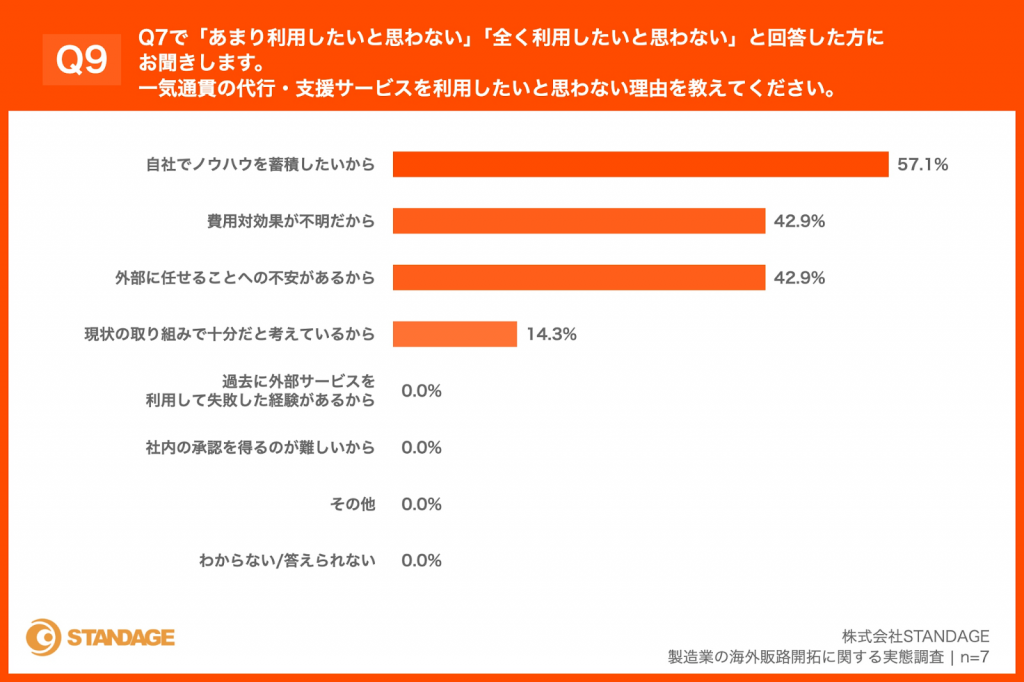
・Because we want to accumulate know-how in-house: 57.1%
・Because the cost-effectiveness is unclear: 42.9%
・Because there are concerns about outsourcing: 42.9%
Because we believe our current efforts are sufficient: 14.3%
- Because I have had a bad experience using external services in the past: 0.0%
- Because it is difficult to obtain internal approval: 0.0%
・Other: 0.0%
・Don't know/can't answer: 0.0%
This time, we conducted a survey on the current state of overseas market development in the manufacturing industry, targeting 110 people who work in the manufacturing industry and are involved in or have experience in overseas market development.
First, the most common measure for developing overseas sales channels was "exhibiting at international trade shows held in Japan" (59.11 TP3T), followed by "participating in JETRO-supported business matching events" (52.71 TP3T) and "exhibiting at overseas trade shows" (50.91 TP3T). 62.41 TP3T of companies responded that these measures "led to continuous transactions and resulted in sufficient profits." On the other hand, when companies that did not achieve the expected results were asked about the reasons, the most common response was "language barriers prevented smooth negotiations and contracts" (46.31 TP3T), followed by "loss of contact with local buyers" and "excessive time and cost spent dealing with local regulations and certifications" (both 43.91 TP3T). Furthermore, among companies without dedicated personnel, the most common issues were "lack of in-house expertise and know-how necessary for overseas transactions" (70.01 TP3T) and "inability to conduct market research and gather local information" (55.01 TP3T), indicating that a lack of resources is a serious problem.
This survey revealed that while many companies working to develop overseas sales channels are achieving some success, they face challenges in creating mechanisms for "sustainability," such as language support, compliance with local regulations, and follow-up systems after business negotiations. In particular, companies that cannot afford to have dedicated personnel are acutely aware of their lack of expertise, highlighting the structure in which participation in trade shows and business meetings alone is unlikely to lead to results. The fact that over 90% of companies expressed an intention to use services that provide end-to-end support from strategy planning to local negotiations, logistics, and payment suggests the existence of these "walls that cannot be overcome by the company alone." In the future, it will be important to strategically utilize external resources to build a sustainable overseas expansion system.
Download this surveyHerefrom.
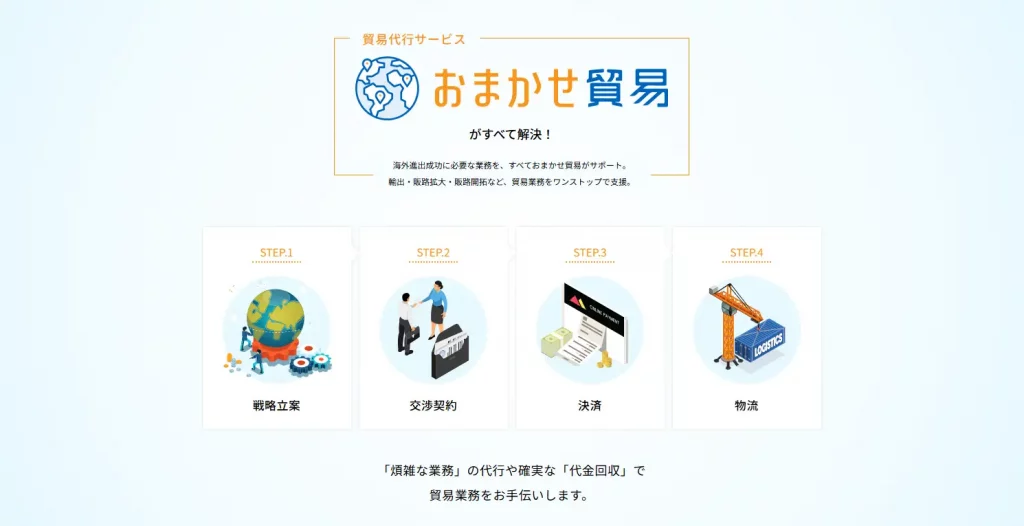
Omakase Trade will support you with all the tasks necessary for expanding overseas. We will cover all your trade-related problems.
With the yen currently at an unprecedentedly low level, expanding into overseas markets presents a huge opportunity for any company. Omakase Trading removes the barriers to such overseas expansion and accelerates your business. We provide one-stop support for overseas expansion, from overseas market research and exhibition participation to sales representation and sales channel development.
For more information:https://standage.co.jp/service/omakase/
Company name: STANDAGE Co., Ltd.
Established: March 7, 2017
Representative: Akira Adachi, President and CEO
Address: Sumitomo Fudosan Landmark Plaza 3F, 1-6-7 Shibakoen, Minato-ku, Tokyo 105-0011, Japan
Business Description: Development and provision of a digital trade platform based on blockchain and AI technologies.
[Contact for inquiries regarding this matter]
STANDAGE Co., Ltd. Marketing Department, Iizuka
TEL: 03-6435-3371 E-mail: info@standage.co.jp
For trade-related inquiries, please contact us here.