Make global trade freer and simpler.
 English
 Japanese

Make global trade freer and simpler.
2026.10.28
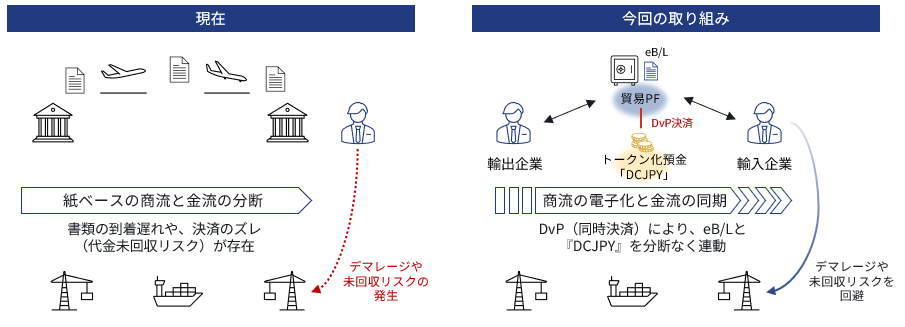
STANDAGE Co., Ltd. (Headquarters: Minato-ku, Tokyo; Representative Director: Akinori Adachi; hereinafter "STANDAGE") and DCP Co., Ltd. (Headquarters: Chiyoda-ku, Tokyo; Representative Director, President, CEO & COO: Yoshio Hirako; hereinafter "DCP") have begun joint studies on a payment-integrated trade platform (PF) with the participation of Shoko Chukin Bank, Ltd. (hereinafter "Shoko Chukin"). With the amendment to the Commercial Code that will legalize electronic bills of lading (eB/L) approved by the Cabinet in October of this year and expected to be implemented in fiscal year 2027, the two companies will verify simultaneous settlement linking eB/L with the tokenized deposit (*1) "DCJPY" issued by Shoko Chukin, with a view to commercialization in fiscal year 2028, anticipating the full-scale spread of eB/L. The aim is to "synchronize the electronic flow of trade with the flow of money" and, in the future, "increase the transparency and speed of the flow of money."
In current trade practices using paper bills of lading (B/L), the risk of non-payment in payment settlements and the time loss associated with mailing paper documents are factors that put pressure on the cash flow of small and medium-sized enterprises (SMEs). Furthermore, the problem of high demurrage charges resulting from cargo arriving before the bill of lading is also becoming serious, making efficiency improvements through digitalization an urgent necessity.
Currently, the environment for the digitalization of trade and finance is rapidly being developed both domestically and internationally. In line with the UNCITRAL Model Law (MLETR), a bill to amend the Commercial Code concerning electronic bills of lading (eB/L) was approved by the Cabinet on October 23rd of this year, and legal preparations for implementation by fiscal year 2027 are now in full swing. Furthermore, against the backdrop of the government's promotion of on-chain finance in its "Basic Policy 2026" and the need for advanced compliance (AML/CFT) in response to stricter FATF scrutiny in the banking industry, the transition to next-generation payment infrastructure utilizing blockchain has become an inevitable choice.
Against this backdrop, the introduction of electronic bills of lading (eB/L) and other technologies is advancing the digitalization of "commercial flows (documents and data)," and an environment is being created to smoothly link digital data with the actual movement of goods, or "logistics (movement of goods)." However, true efficiency in the overall trade procedure cannot be achieved as long as the final "flow of money (payment)" remains separate from these processes. Furthermore, traditional overseas remittances via SWIFT and other methods require time and cost to receive funds, and the uncertainty of cash flow is hindering the global expansion of small and medium-sized enterprises (SMEs).
To address the "separation of commercial/logistics flows and financial flows," which is the biggest bottleneck in trade DX, we will begin joint studies using this model and proceed with preparations for a demonstration experiment.
The first phase of this initiative aims to demonstrate the "synchronization of commercial transactions and financial flows" by linking trade documents such as eB/Ls with tokenized deposits, and to establish a practical operational model for commercialization in fiscal year 2028. This will eliminate time lags and improve operational efficiency in the trade operations of small and medium-sized enterprises (SMEs). Furthermore, with an eye toward future connectivity to cross-border payment networks, this initiative will develop into "transparency and acceleration of financial flows," contributing to the construction of a sustainable social and industrial foundation in Japan by reducing overall trade procedures costs, ensuring transparency in supply chains, and increasing resilience.
This initiative aims to build a DvP settlement scheme that links electronic bills of lading (eB/L) with tokenized deposits "DCJPY". The following benefits are anticipated from the realization of this scheme:
Through future pilot projects, both companies will accelerate the establishment of systems, technologies, and practical workflows, with a view to the following developments toward commercial service launch in fiscal year 2028.
(*1) Tokenized deposits: These are bank deposits that utilize technologies such as blockchain to allow deposits to be handled digitally. By combining them with smart contracts (automated execution programs), they enable advanced business automation and instant settlement.
(*2) About CargoX: CargoX is a global electronic bill of lading (eB/L) management platform developed by CargoX Inc. and approved by the International P&I Group (Mutual Marine Insurance Association). It also meets the international standard interoperability requirements set by the non-profit organization DCSA (Digital Container Shipping Association), and is evaluated as a scalable and reliable system that will enable seamless data exchange between different eB/L platforms in the future.
[reference]
Announcement of this initiative by Shoko Chukin Bank: For Shoko Chukin Bank's announcement regarding this initiative, please refer to the company's press release issued on the same day.
https://www.shokochukin.co.jp/assets/pdf/nr_261028_01.pdf
Company Name: STANDAGE Co., Ltd.
Established: March 7, 2017
Representative: Akira Adachi, President and CEO
Address: Sumitomo Fudosan Landmark Plaza 3F, 1-6-7 Shibakoen, Minato-ku, Tokyo 105-0011, Japan
Capital: 367 million yen
Business activities: Development and provision of digital trade platforms (trade cloud, digital trade payment) and trade settlement systems using blockchain; provision of export support services for small and medium-sized enterprises ("Omakase Trade") (outsourcing and support of overseas market development and trade operations).
URL: https://standage.co.jp/
Company Name: DCP Co., Ltd.
Established: December 27, 2021
Representative: Keisuke Hirako, Representative Director, President & CEO & COO
Location: 2-10-2 Fujimi, Chiyoda-ku, Tokyo
Capital: 100 million yen
Business Description: Digital currency business / Electronic payment service provider. Kanto Local Finance Bureau Director (Electronic Payment) No. 150
URL: https://www.dcjpy.com/
■ Contact information regarding this matter
STANDAGE Co., Ltd.
Marketing and Public Relations
TEL: 03-6435-3371
E-mail: info@standage.co.jp
For trade-related inquiries, please contact us here.